Showing posts with label obsessed bookworm. Show all posts

Saturday, September 17, 2016

The Hamilton Affair


The Hamilton Affair - Elizabeth Cobbs. This wonderful historical novel follows the lives of Alexander Hamilton and his wife, Elizabeth Schuyler. Each chapter alternates Alexander's and Eliza's point-of-view, beginning in their wildly different childhoods -- Alexander's in the Caribbean, and Eliza's in New York.

The Hamilton Affair is richly grounded in history and a joy to read. My only nitpick is that one of the characters, Ajax Manly, is fictional and he seemed that so much that it broke my concentration at times. 

Here's what's wonderful: You can read this book and shout out Hamilton lyrics on practically every page. (The cover even looks like one of the Hamilton posters.) 

Here's what makes me want to read more of Elizabeth Cobbs: She's a subtle writer. She really got to me emotionally towards the end of the novel by an almost offhand reference to something at the beginning of the novel. It was so elegant, so understated, so powerful...there I was at 3 a.m. sobbing. "HIS SHOE!"  This example should be taught in creative writing seminars everywhere.

What else to say? Nothing but read it, read it, read it. Or listen, listen, listen. I have a feeling that this is a great audiobook.

Sunday, July 17, 2016

Nothing But Hamilton

Here I am at mid-month, awash in Hamiltonia.

 Although I've been working on Ron Chernow's biography of Alexander Hamilton since May 15, I didn't really catch fire till now when I finally got the soundtrack to the musical and in very quick succession, Hamilton: The Revolution, the libretto by Lin-Manuel Miranda chock-full of his thoroughly entertaining, slightly nerdy notes. I polished it off like candy or potato chips. Delicious. The soundtrack is in constant rotation on my devices and in my brain.

Taking a deep breath, I jettisoned some of my reads, returning the Dylan Thomas and Hildegard Knef biographies to the library. I've cleared the decks, and it's nothing but Alexander Hamilton's biography until I'm finished. I'm at 41% now, and I should be done by the end of this month. Bet you ten bucks.

Friday, July 03, 2015

My Stewart O'Nan Summer

West of Sunset - Stewart O'Nan.  Instead of the predictable Gatsby-era take, O'Nan explores the last three years of F. Scott Fitzgerald's life, when he was employed in Hollywood as a scriptwriter. This book hit all my happy buttons: Scott hangs with Dorothy Parker and Robert Benchley, and even better, Humphrey Bogart is his neighbor. Also, seen through Scott's eyes during brief visits, Zelda comes to life even more thoroughly than she did in the famous biography of her by Nancy Milford. O'Nan so accurately conveys the weird combination of tenseness and tedium that goes with spending time with someone experiencing mental problems. This is O'Nan's latest novel (published early in 2015) and although I haven't made it through all of his works yet, I have a feeling that this is his best one.

The Night Country - Stewart O'Nan. One Halloween night, five teenagers riding around in a car are in a fatal accident. Three die, one suffers severe brain damage and the other is unharmed. The novel properly begins on the first-year anniversary as the ghosts of the three dead teenagers follow the actions and thoughts of the unharmed teenager, who has survivor's guilt; the mother of the brain-damaged survivor, and the cop who was there when the accident happened. There's that same slice-of-life quality that made Last Night at the Lobster so good, but it's also quietly chilling with flashes of sharp, dark humor, like a Shirley Jackson novel.  The ending reminded me of a Coldplay song and I wanted to weep. Weighing in at less than 225 pages, this 2003 novel by O'Nan would be a great read for the R.I.P. Challenge.

The admiration continues. Next up: Wish You Were Here.

Sunday, May 31, 2015

New Bookworm Crush: Stewart O'Nan

My last big author obsession was Emile Zola. It's been nearly three years, so I knew I was due to fall in love again.

A couple of years ago, I read Last Night at the Lobster, a short novel by Stewart O'Nan that follows the last evening of work for employees of a Red Lobster that is closing. The novel seemed so close to real life, as if O'Nan had just shown up like Tracy Kidder and hung out and reported what he saw and heard. When I started thinking that he hadn't really done anything, I realized that he had done something. It was one of those koan moments.

Flash-forward to last week. I was browsing the county library and I found a shelfload of Stewart O'Nan novels. Wonderful! I hadn't realized that he'd written so many. He's also written something with Stephen King. Uncle Stevie! How did that information elude me for so long?

Anyway, I checked out O'Nan's 2012 novel The Odds, which is about a couple who have been married 30 years. They have both recently lost their jobs and are on the brink of bankruptcy and divorce. In a bold move, the husband proposes that they liquidate the rest of their assets, take a "second honeymoon" to a hotel/casino in Niagara Falls (Canada) and make some seriously big bets. This is one of the best novels about marriage that I have ever read.

After finishing The Odds, I went on to an earlier O'Nan offering: Everyday People (2001). This is the one I'm reading now. This novel takes place in O'Nan's native Pittsburgh and describes the lives of several acquaintances in an African-American neighborhood. I've been reading with a critical eye this time, looking for and fearing any missteps or falsity on O'Nan's part, but so far, I've not been disappointed. It's a wrenching story, full of dignity and beautifully told.

I'm not sure which novel I'm reading next, but I am sure that this is going to be my Stewart O'Nan summer. Maybe it can be yours as well.

Tuesday, August 31, 2010

August, 2010: Buying

I haven't added up my total purchases for the year. I keep telling myself, "Not yet, not yet." I keep reassuring myself that I can't be up to 100 books yet, but after last month's crazy (but oh-so-enjoyable) binge, I'm beginning to get the feeling that I might be closing in on that old triple digit.

Although I meant to approach this month with austerity, my obsession with Harry Paget Flashman showed no signs of waning after I read Flashman and Royal Flash, so I found myself at Amazon one evening ordering these books:

1. Flashman at the Charge - George MacDonald Fraser. At the charge of the Light Brigade, of course. I thought that this might be the one in which Tom Brown's School Days is published, but I was mistaken -- that's Flashman in the Great Game.

2. Flash For Freedom! - George MacDonald Fraser. Flashy spent quite a bit of time in America, which should make for interesting reading. According to his "biography", he fought on both sides of the American Civil War, but those "papers" were never found.

3. Flashman and the Redskins - George MacDonald Fraser. An un-PC title to go with an un-PC character. Flashman is at Little Big Horn in this one, I believe.

I told myself that the Flashman buying binge was my reward for teaching science to children at summer camp. Then, after camp was all finished, I realized that I hadn't made my acquaintance with the new What The Book? store yet. Once I was in the much improved new location, I had to express my delight (about camp ending and the nice new bookstore) somehow:
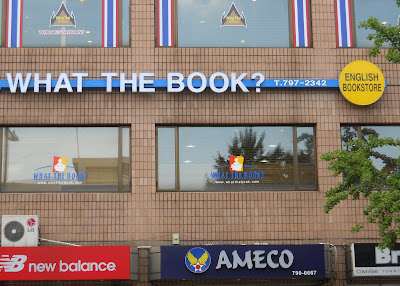

4. You Gotta Have Wa - Robert Whiting. An examination of Japanese baseball, or as they say, besuboru. One of these days, I've got to hie myself over to Tokyo or Fukuoka during baseball season and watch a few games.

5. Winter's Bone - Daniel Woodrell. This is the second time I've bought this book. I picked it up at the request of my former colleague Pablo back in 2006 or 2007 during my trip to the US. I remember that wanted to read it before I passed it on to him and collected the money, but decided that it wouldn't be good manners. This will be my first Woodrell novel, although as a novelist from Missouri, he's been in my peripheral vision for several years. I liked the movie version --Ride With The Devil -- of his novel Woe To Live On. After I read Winter's Bone, I hope to see the movie, which has done very well critically.

6. Dead Poets Society - N.H. Kleinbaum. Eeek, a movie novelization! I used to read novelizations a lot when I was a teenager. My favorite place to buy books was the TG&Y store in Lawton, Oklahoma. I remember the rack being thick with them. Gradually, I moved on to reading actual books before they were made into movies.

So why have I regressed? This semester, I have an Intermediate English Conversation class that meets 2 times a week for 2 hours at a time. That's a lot of face time, so I'm going to build a book group into at least one of those hours. Since many young Koreans seem to really identify with this movie/book or are at least familiar with the storyline, I'll try it on for size. We'll finish the semester with a viewing of the movie.
.
7. The Secret Life of Bees - Sue Monk Kidd. Same reason as #6, except that it's for my Beginning English Conversation class. Not one of my favorites, but I think the students will like the book, which came out well before the movie.

Saturday, April 04, 2009

Little Women and the Feminist Imagination


Would it be too geeky to say that I haven't read any literary criticism for ages and therefore, I had a wonderful time reading the essays in Little Women and the Feminist Imagination? Little Women is one of those books from my childhood, but I only recently read the whole novel all the way through and enjoyed it thoroughly.

My dream a few months ago about having to give a lecture about Little Women was still fresh in my mind when I descended on Little Women and the Feminist Imagination and decided to make it part of the first wave of my library loot. I galloped through it in a matter of days. Here are some of the essays that stood out for me:
  • "Waiting Together: Alcott On Matriarchy" This was a comparison of the Bennet girls and their mother in Pride and Prejudice and the March girls and Marmee in Little Women. In a nutshell, Mrs. Bennet sends her daughters out into the world to find their husbands. Marmee keeps her daughters close to home and the men are attracted to their home and hearth.


  • "Reading For Love" Catharine R. Stimpson introduces the idea of the "paracanon" -- books that we read not because they're "the best of the best" but books that are loved regardless of their stature. "...If a beloved book were human, it would embrace us." "We are grateful to the beloved text for being there." "The reader and text are a couple." Strange as this sounds for a discussion in a volume of literary criticism, it's got a familiar feel. Stimpson makes the excellent point that finding out about students' paracanons could go a long way in informing and creating a course syllabus.

  • "Portraying Little Women Through The Ages" is a discussion of the three film versions. Personally, I love the 1933 version. Angular and New England-bred, Katharine Hepburn is the perfect Jo. The other sisters don't seem quite right, but Hepburn and George Cukor's direction and his respect for the book make it all okay. Second on my list is the 1994 version. The spirit of the novel shines strongly, but they mess with the text too much. All the sisters seem right -- maybe Winona Ryder a little less than the others, but I love her, anyway. Laurie (Christian Bale) is just as I always imagined him. Marmee is slightly too modern, but hey, it's Susan Sarandon and in my book, she can do what she likes. Gabriel Byrne finally gave fans of the book and films a Professor Bhaer that's easy on the eyes. Running an extremely distant third is the execrable 1949 version with June Allyson as Jo. If you haven't seen it, run right out and avoid it. The casting sucks (except for Margaret O'Brien as Beth, which is undercut by having Elizabeth Taylor play her younger sister Amy) , the direction sucks, the music sucks, it's too Technicolor-y. Ugh.

  • "Getting Cozy With A Classic: Visualizing Little Women (1868-1995)" A discussion of some of the many illustrators of Little Women. The book has never been out of print, so there have been hundreds, maybe thousands of editions. Four illustrations from the first edition are included in this essay. They were done by May Alcott, Louisa's sister. To call them bad is almost like a compliment, as if they were real art. Girl couldn't draw. Having said all of that, I did enjoy seeing them from a historical perspective. Poor May's drawings were dropped in favor of an illustrator named Billings for the 1870-something edition, then in 1880, Frank Merrill did a great job, but unfortunately, this is also the edition that was published by Roberts Brothers, who got the bright idea to "clean up" Louisa May Alcott's text by removing slang, colloquialisms and "correcting" the characters' grammar. Happily, the original text was restored during the 1980s. The author of this essay, Susan R. Gannon, points out that the same things seem to get illustrated over and over, like Marmee with the girls around her chair as she reads the letter from Mr. March, exhorting them to become you-know what. Gannon particularly examines what illustrators have made of the skating scene, in which Jo (who is seething because Amy burned the book Jo had been writing for her father) fails to warn Amy that the ice is softening, and Amy has an accident. All of them, from May Alcott on down, avoid Jo's murderous anger. May Alcott drew Amy as a fashion plate, skating confidently on the ice, Frank Merrill played up Laurie as the rescuer and other editions have shown Jo weeping on her mother's lap after it's all over.
    .
  • "Queer Performances: Lesbian Politics In Little Women" Was Louisa May Alcott a lesbian? Was Jo March? (The ideological kind, rather than the genital kind) Homosocial relationships are the strongest in the novel. "Patriarchy ultimately divides and conquers the women who empower each other through their love." Okay...
  • .
  • Another essay, written by a male, wonders what is there to attract the male reader. The best bet would be Laurie, but as Jo is a boyish girl, he's a girlish boy...a 5th sister. He finally realizes his dream of being part of the March clan after Beth's death makes a place for him. The other men are indistinct.

  • David Watters takes a look at the novel via architecture. He notices where scenes take place and what these places and rooms typically meant to a 19th-century reader.

  • "Communities of Education in Bronte and Alcott" As even casual readers of Charlotte Bronte know, she had an extremely negative view of education, whether it was on the teaching side or the student side. Alcott shares some of this negativity (Amy's bad experience at school with Mr. Davis and the pickled limes), but seems optimistic that education can be done right, as with Jo's work at Plumfield in Little Men and Jo's Boys. Alcott was an outspoken admirer of Bronte's work, saying it possessed both brain and heart.
  • "Learning From Marmee's Teaching" This essay discusses the miseducation of girls both in Alcott's time and in the 1990s. Marmee's firm belief in volunteer work and her feeling that helping others was a panacea for many ills (although this zealousness led to Beth catching scarlet fever from the Hummels) has its modern-day echo in Mary Pipher's Reviving Ophelia.

  • While some of the essayists regarded Jo's marriage as a failure or simply tragic, others read the trilogy and focused instead on what Jo became -- a successful writer and educator with loving family all around her. Professor Bhaer allowed her to flourish; he let her be her own person.
  • Janice Alberghene, one of the co-editors of this volume, compares Little Women to a 1948 novel by African-American writer Dorothy West titled The Living Is Easy. Cool! I had no idea this novel even existed. One more for the wishlist!
  • "Alcott In Japan: A Selected Bibliography" Compiled by Aiko Moro-Oka. Disappointment. The introduction to this bibliography is a scant two paragraphs. First translated into Japanese in 1906, Little Women is really popular in Japan because "most Japanese families lived simply and creating a happy home was their ideal". Also, "Young women were encouraged to aspire to careers by Jo's energetic and independent way of life." I wish there had been more discussion. How did Aiko Moro-Oka respond to the novel? Personal recollections from a sampling of Japanese women would have been nice as well. If the Japanese like it, I wonder how the Koreans feel. I did see a Korean copy of it a couple of years ago in the bookstore at the train station in Gumi. I picked it up and was pleased that I could pick out the characters' names in Hangul.
Right now, I'm all about Alcott. I went out and bought Jo's Boys this weekend. Do you think my book group might consider reading Little Women?