Showing posts with label korea. Show all posts

Thursday, May 12, 2016

Shut the Book Up: Without You, There is No Us by Suki Kim (DNF Files)


Since I taught university students in South Korea for ten years, I wanted very much to like Suki Kim's memoir of teaching the sons of the North Korean elite at a university in Pyongyang.. How were the students different? How were they alike?

I only got a mild glimpse at Kim's students before I gave up and shelved this memoir. I was hoping for more focus on her current situation. Instead, there was a good deal of moaning about a bad boyfriend back in the States. New York? I can't even remember.

More interesting was the backstory of her family, which Suki Kim begins with the story of her mother and her grandparents fleeing south during the Korean conflict. A few decades later, her parents made the decision to pull up stakes and move to the United States.  However, Kim's writing style failed to engage me, and I stopped reading before she returned her attention to her North Korean students.

I also have a vague sense (I'm not sure why, but it persists...maybe an article I read and half-remembered?) that Kim's memoir/reportage wasn't entirely responsible or discreet. This may be unfair to the author, but it colored my reading and eventual abandoning of the book.


Sunday, March 22, 2015

Even If the Sky Falls Down Book Giveaway WINNER

Sorry I'm late posting this. The winner of my e-book giveaway is Kayla Stratton.

Congratulations, Kayla! A copy of Even If the Sky Falls Down will be sent to you soon.

Thanks to everyone who entered the giveaway or left a nice comment about having already purchased the book. That means so much to me; you can't imagine.

Wednesday, March 11, 2015

11th Blogiversary + Book Giveaway


Blob turns eleven!  11 blog years. How much is that in dog years?

To celebrate, I'm giving away a free copy of my novel, my e-book, Even If the Sky Falls Down. To register for this giveaway, leave your name and email (@ and . spelled out of course) in the comments section. This giveaway is open to international participants. A winner will be randomly selected on March 20 and announced on March 21.

Wow, it just dawned on me (never very good at math, hence the slow realization) that next year will be twelve years. One dozen. I can't wait.

Thanks so much for being a part of my Read Life. Even after all these years, I'm still awestruck that cyberspace is large and contains multitudes of book lovers.

Thursday, March 05, 2015

"Either This Wallpaper Goes, Or I Do"

Because Dorothy Parker and Vladimir Nabokov lived in hotels, I really thought I would like to as well. When the lease was up on my apartment and I still had a month or so to go in Korea, it was exciting to finally realize one of my literary fantasies.

It's been about ten days and I've decided that I couldn't do this on a permanent basis unless I had a hotel suite rather than just a room. That was a possibility, but I had to stay within a certain budget. I've got two weeks to go, but who's counting?  I am.

To begin the virtual tour, it's a room with no view. There is some kind of steel thing in front of the window. If I crane my neck upward, I can get a glimpse of the sky. Good thing there's television because it keeps me from having to look at the wallpaper. 

Did I say wallpaper? I meant to say wallpaperS. I counted one morning, and there are six different wallpaper patterns in that one room:

1. Zebra - This is the main pattern. It covers two-and-a-quarter walls.

2. Shiny Black Roses - This is on two beams. I think they are beams.

3. Cellular Mitosis - This is on the window-with-no-view wall. A two-foot strip. The background is cream-colored and the cells are black and blue.

4. Shocking Lime Green - The headboard.

5. Brown Gingham - This comes after the cellular mitosis, finishing off the window wall, and continues on to the wall opposite the bed, where the TV hangs.

6. Red-and-White-Checkerboard - This is around the light fixture on the ceiling, and nowhere else. Meant as a flourish, or did the decorator just get tired? Nausea is also a possibility.

There is a long counter that runs the length of the TV wall. It's bright green.  A small dining table with two chairs are next to the window wall. The chairs are covered in lime green crushed velvet. The bedspread is orange and pink.

The bathroom -- fixtures, floor, walls, towels -- is stark white. It's restful. There's a bathtub, so I go there often.

When I'm in the room, I find myself unable to read more than a few pages at a time. Writing? Forget it. I watch a lot of CNN and BBC.

Oscar Wilde died in a cheap hotel in France. During his last illness, he famously remarked something along the lines that he was "...fighting a duel to the death with this wallpaper. Either it goes or I do." I wonder what his wallpaper looked like.  What would he have made of the haphazard pastings in my room? Perhaps they would have killed him off weeks earlier. I prefer to think that they would have jolted him back to life.


Sunday, February 22, 2015

Even If the Sky Falls Down

I'm excited to announce that my novel Even If the Sky Falls Down is finally complete and available at Amazon.com.

Thanks to everyone who left comments of support and encouragment on this blog during the writing and editing process.
 

Thursday, February 05, 2015

To BEL With Love


One of the things I'll hate about leaving Busan is saying goodbye to the Busan English Library. The BEL has given me so many hours of happiness. I wanted to say thank you by donating some books from the Bybeeary that didn't make the final cut of books sent to the United States.

 I gathered up some serious, yet engaging titles -- pristine beauts with uncracked spines (nothing but the best for my beautiful library!) and made my way BELward.

Bybee: [to woman at the front desk] Hi, I'd like to donate these books to the library.

Front Desk Woman: [looks at books with an oh-God-no expression] Donation?

Bybee: Yes, donation.

FDW: Just a minute. [gathers up books and heads for an office on the other side of the room]

[Bybee wanders off to the "New Books". About 3 minutes pass. FDW comes back with a new woman in tow. Office Woman?]

Office Woman: Excuse me! You want to donate these books? [holds them away from her as if they're radioactive]

Bybee: Yes. Is everything OK? [thinking OMG, they don't want my books. Crap. Now I have to haul them back to the apartment.]

OW: If we have don't have a copy of any of these books, we will add them to our collection. If we have a copy, or they aren't suitable, we will re-donate them to another place. Do you understand? Is that all right?

Bybee: Yes, of course. Sure.

OW: Do you live in Busan?

Bybee: Yes, I come here all the time. I have a library card. [Bybee curses inwardly as she suddenly realizes that she left her BEL card at home on the table]

OW: Where do you work?

[Bybee says the name of her soon-to-be-former workplace]

OW: I studied there. Do you know Professor ____________?

Bybee: No, I'm sorry, I don't.

OW: When did you start working there?

Bybee: March, 2013.

OW: I was there in 2012. You don't know Professor __________? What do you teach?

Bybee: English conversation. To freshmen.

OW: Professor ______________ is English Department.

Bybee: Ah, yes. I see. Well, I don't know him.

OW: How long have you lived in Korea?

Bybee: Ten years. [starting to get that sweaty, interrogated feeling. Looks around for the bright, hot lights and the rubber hose]

OW: You've been here ten years?

[Bybee nods.]

OW: How did you acquire books of this quality?

Bybee: Uh, well, uh...I uh, shopped? And uh, I ordered some online? And when I visited my hometown... [sweat pops out in new places]

Bybee: [inwardly] WHAT DO YOU MEAN, HOW DID I ACQUIRE BOOKS OF THIS QUALITY? DO I LOOK TOO POOR OR TOO STUPID TO SHOP? EXCUSE ME FOR NOT BRINGING IN A BAGFUL OF BEAT-UP JAMES PATTERSONS! HOW DID I ACQUIRE THESE HIGH-QUALITY BOOKS? DO YOU THINK I STOLE THEM? YOU THINK THEY'RE HOT??? OK, OFFICE WOMAN, I CONFESS...I'M IN AN ILLEGAL BOOK RING! THAT'S WHY I MOVED TO BUSAN --  SO I COULD MORE EASILY ENGAGE IN SHADY BOOK DEALING AT THE DOCKS! CONGRATULATIONS, YOU WORMED IT OUT OF ME!

OW: [nodding] You bought them.

Bybee: Yes.

[Office woman nods again, finally cracks a slight smile, then turns around and walks back to her office, carrying the books. The high-quality books. Bybee waits a moment to see if she's really dismissed, then staggers over to the magazine section to sit down and recover]

Perhaps the stress of repatriating is getting to me, but that seemed a little over-the-top, even taking cross-culture communication and second-language semantics into consideration.

 I love you to pieces BEL, and I'll be back to visit often before I leave at the end of March, but don't worry. I'm not bringing in any more donations. The next time a foreigner comes waltzing in with an armload, just take the damn books. A thank-you would be nice as well.
 

Monday, January 26, 2015

Modern Korean Poetry: Between Sound and Silence - Chang Soo Ko


In keeping with the spirit of surrealism that pervades Chang Soo Ko's poems, I'll start by saying that this book allowed me to find it at just the right time. It hollowed out for itself a space in my life. My relationship with Korean literature is skittish, but Between Sound and Silence was having none of that. Finding me alone at work on a slow day, it held me to my chair. The book was a suitcase whose contents I unpacked slowly and with great delight. Or was I the suitcase, and the book unpacked me, watching my reactions unfold?

Between Sound and Silence, published in 2000, is a handsome volume. A hardcover with delicately textured cream-colored end papers, it is a bilingual offering with the English version on the left-hand page and the poem in Korean on the facing page. The poet (who has also served as an ambassador for Korea) did all of his own translation, which further excited my admiration. This is one of the few times I've wished to be fully fluent in Korean, so I could get the total flavor, the complete experience of what Ko is saying. Perhaps I wouldn't survive the full impact, though. For example, a line like Let some melodies illuminate the words hanging in our trees packs quite a punch just in English.

The first poem in this collection, "At the Art Gallery" starts with a stark imperative sentence, bursting with the energy of a coiled spring upon release: Do not think you are the only one in his perspective. Immediately, my brain began to buzz. Who is the "you" in the poem? Who is the one with the perspective? Reading the poem one way, it seems as if "you" is the spectator. In another reading, I was convinced it was the painted image. And what about the artist? His eyes always reflect the flickering flames from his center. Do not think they miss your stillness. His gaze penetrates far beyond where there is only silence. Drowning in all the pronoun possibilities, I finally had to conclude that it's really a poem about Ko and his reader and the journey they're about to embark. But again, there's shifting and blurring and the uncertainty: Is Ko talking to the reader or talking to himself, or imagining what the reader might say?

The reason I'm going on about poet/poem/reader relationships is because of the poem "To Marc Chagall" in which Ko articulates the feelings that we've all had for painters, poets, writers, actors and directors that have affected us viscerally:

I want to define our relationship more clearly.
Though my human shape never cast any shadow on your life,
my glances often fed the flames of your candelabra.
The bare winter branches in your landscape
sometimes lit up with my pastels.
You sent through my nightmares your silent birds
dripping with burning pain, 
and tempered my emotions.
Our relationship has been a metaphysical one, at least.
But this definition is pointless
like a mountain perspective overlooking human events.

Pointless?  I don't think so.  As for the "mountain perspective", that's definitely not pointless. In Ko-World, static things such as locations are anything but, and the depth of their importance cannot be understated. In "Camera in the Park" when he muses on What happens inside it, on the other side of the lens? We get the point-of-view of the landscape: ...the landscapes that long for light and motion, stir quietly as summer. The landscape appears again as an active participant in a poem that bears its name:

The landscape at times lets a bird fly away, 
shedding blood drops among the foliage,
or lets a calf moo plaintively on a hill.
With its gentle breath
it sends away bright blossoms
and calls in honeybees and birds,
or gently guides sea-bound sailors to their endless voyage.
The landscape attracts things and creatures
with the irresistible force of its gravity,
and absorbs into its essence
laughter or glance, flame or flower.
This is just as sounds gravitate into silence.
The landscape quietly breathes, submerged in the sky.
As if pulled by some force beyond the horizon,
a strange bird draws an inexplicable parabola in the air.

Finally, a landscape melts inside me:
a commonplace and simple landscape;
A childhood landscape with a tree and a rock,
where I desperately called a name,
gradually melts away inside me.

All my life, jaunts into the countryside have been tedious events. With the above poem, Chang Soo Ko has put an end to that. The next time a rural landscape permits me to set foot in it, I'll be a trifle uneasy, but certainly not bored.

Ko can be weird and intense, but he also does weird and cute well, as is evidenced in "Ocean-liner":

Slowly the ocean-liner
Moves in dreamy motion
As if an island were shifting gournd,
Weary of its fixed gravity.

Like a baby whale coming for milk,
The pilot boat comes near,
Snuggles the ship for a while
And then reluctantly moves away,
Leaving the island on the sea.

A little hurt despite its elegance,
The ocean liner struggles over the boundary
Between affection and disowning
And gradually travels into memory.

Sometimes he explodes into fun and rolls around in language like a kid in a big pile of raked leaves ("Joke About Culture"):

Our culture in its broadest sense largely determines:
Whether we practice monogamy, polygamy, or hierogamy
Whether our madness is schizophrenia, spirit-posession or psychedelic
Whether we love monologue, dialogue, or paradox
Whether our viewpoint is bird's-eye-view, fish-eye-view or simply belle-vue
...Whether we consider nature a friend, a foe, or a dump...
Whether our life is dominated by by-laws, in-laws or outlaws.

Then there are his creature poems, in which Ko mimics perfectly the style of movement of subject of the poem. Of course both poems somehow manage to be about the poet/reader relationship. How does he do it? But of course, most great artists have a single theme and they attack it repeatedly in a range of variations.

"What the Spider Said" is divided into seventeen sections (Why seventeen? It's driving me crazy.That can't be arbitrary.). Here are my two favorites:

7.
I seem to grasp the real motives of
The mountain-climbers.

15.
I arrange and rearrange reality
In my fool-proof webs,
Making everything visible from my perspective.
Look, with what authority I order and command
The elements to conform to my grammar!

And a very different creature ("A Cat's Landscape"):

When the cat walks away,
the landscape quivers a little.

Those are my favorite lines, but the whole poem is neat, the way it alternately stalks and undulates.

There's no way I can do justice to the poems of Chang Soo Ko, but I've given it my best shot. I'm a little humbled and freaked-out that I wasn't aware of his work for the whole decade I've been here in Korea, but his poems found me now that I'm within a hairsbreadth of  leaving...forever? Once I step on the plane, the process of this 'landscape gradually melting away inside me' will begin.

I suppose there will be some sort of send-off for me, a leaving party to mark the occasion. Although no one gave it to me and the book is not mine to keep, Between Sound and Silence feels like my going-away gift:

Hey Susan, 

Here's some poems. 

Love Always, 
Korea

Tuesday, December 02, 2014

November: Reading and Writing Cage Match


So, November was National Novel Writing Month.  Reading was to take a back seat, or perhaps get out of the car and take a bus.  But you know what? Reading did not go quietly.  When Reading saw an opportunity to triumph over writing, Reading was not shy about pressing the advantage. Here are the highlights:

1. Hangover Square - Patrick Hamilton.  Hamilton had me jumping every which way in this black comedy that's sort of like Mr. Hyde and Mr. Hyde.  George Harvey Bone, the main character, is an oversized alcoholic who idly spends his days at the cinema waiting to drink again in London with a particularly nasty bunch who barely tolerate his presence. His chief attraction to this group is Netta, a would-be actress whose beauty is only just skin-deep.  George Harvey Bone is also mad. With a click, he goes into "dead moods" in which he realizes how badly he's being treated by Netta and makes meticulous plans to kill her.  I didn't know which way to turn! Part of me wanted George to stay in his dead mood and finish off the despicable Netta and her equally horrible friends, and the other part of me wanted him drop that crowd and go towards the few people who appreciated him.  This unease about the character is heightened by the setting of the novel:  England is but months from war with Germany.  Neville Chamberlain has just made the "Peace in our time" speech.  Hamilton's writing is freakish and brilliant.  I couldn't leave this book alone till I finished it, NaNo or no.

2. Friends with Boys - Faith Erin Hicks.  YA Graphic novel.  Maggie, a homeschooled young girl in maritime Canada with three older brothers enters high school.  With all the awkwardness of starting high school and public school, she also is haunted by the ghost of a 19th century sea captain's widow. I love Hicks' art, that very clean looking black and white ink style.  I loved the family dynamics. I loved their Canadian-ness.  I loved that I had a library I could walk to and get away from my computer and NaNo.

3. The Life-Changing Magic of Tidying Up - Marie Kondo.  The Japanese decluttering expert has a system for ridding one's life of clutter: Make categories (clothes, books, etc.) and individually handle each item asking: "Does this spark joy?"  If it doesn't, throw it out.  Sounds weird, but it works. Kondo herself has a weird sort of OCD charm.  Her favorite book is Alice in Wonderland.  It shows.  Oddly relaxing, like lying back with a cool cloth on my forehead after spewing words hour after hour after hour during NaNo.

4. The Unabridged Journals of Sylvia Plath - Sylvia Plath.  What a pair we made, Sylvia and I.  Running away from NaNo and my writing block, I fell upon the futon and started reading about SP's writer's block which seemed to leave her when she journalled. She always had plenty of words to beat herself up about not writing.  And this, always this as a refrain: "Learn German."  The only time she seemed quiet(er) in her mind was when she was observing something in nature. Maybe being a scientist would have saved her, although that is a preposterous thing to say 50 years on.

5. The Life-Changing Magic of Tidying Up - Marie Kondo.  At this point NaNo was going reasonably well, but I still felt the need.  The need for read!  Especially on the subway.  So I read this again and basked in the idea of having so few belongings and so much space that things could be stored vertically. Even folded things like shirts and socks and underwear.  Then I would get off the subway and fly into a tidying frenzy. Even as I write this, I want to get up and start tidying now. This book is strange, and sometimes a little cheesy, but it got under my skin. Worth the Kindle price of $9.99.

6. The Slaves of Solitude - Patrick Hamilton.  In this novel, the war is on and rationing is making its painfully pinching self felt. Miss Roach has moved into a boarding house in a small town near London to escape the Blitz. Life is a series of small aggravations growing larger and larger, like the pompous old boarder with whom she has to eat dinner each night who has decided that she's fair game for his hateful remarks. There's also the American Lieutenant who sees all of England as his very own pub and brothel, and may or may not be Miss Roach's sweetheart.  Then there's Miss Roach's acquaintance, the German-born Vicki, who becomes the very definition of "frenemy".  As in Hangover Square, there is lots and lots of drinking, except with rationing, whiskey is in short supply, so it's mostly gin served up every conceivable way.

7. How Koreans Talk - Sang-Hun Choe and Christopher Torchia.  I was using this as a reference during NaNo since that project is set in Korea, but when the writing was going slowly, I ended up reading huge chunks and eventually finished it.

Still working on:
Insomnia by Stephen King.  I dipped into this novel at intervals, trying to absorb King's storytelling technique.  Trying to figure out how he avoids adverbs, only to find them cropping up here and there.  I was reassured.  More often than not, after a session with Uncle Stevie, I felt like I could NaNo again.

Saturday, October 25, 2014

Bookworm in Busan: Gukdo Art Cinema

When I'm not reading, I enjoy watching a movie, which is actually another form of reading, isn't it?

One of my favorite places in Busan is the Gukdo Art Cinema.  It was difficult to find, (the map is unsatisfactory; I got lost several times and asked a half-dozen people) but well worth it.  GAC is a hidden gem for those who crave something other than big-budget action movies.  Every week, GAC brings in several films from different countries and usually shows one right after another.

Here are some directions I hope will be easy to understand.  (I've got some accompanying pictures, but am having trouble uploading them.  When I get them uploaded, I'll add them to this post.)

Directions to Gukdo Art Cinema:

1. Go out of Exit 3 at Dayeon station.  Immediately do a 180, walk a few steps and follow the sidewalk to your left, around the corner.

2. Stay on this sidewalk, walking for about 5 minutes.  You'll pass a lot of restaurants and a couple of hotels and a PC room.  The last thing you'll see is a big tire shop.

3. You will come to a huge intersection where you will see the U.N. Memorial statue.  Cross at the crosswalk.

4. Veering slightly to your right, cross at the next crosswalk.  It looks like a narrow red road framed in crosswalk/zebra crossing lines.

5. Walk along the sidewalk.  The sidewalk curves around the big parking lot of the Busan Museum. The U.N. Memorial statue should be on your right side.

6. Follow the curving sidewalk on around until you get to a crosswalk.  Cross here.

7. When you are on the other side, turn and go to your left.  Walk until you run out of sidewalk.  You will see a Hankook car repair place.

8. Turn right, and stay on the same side of the street, opposite the Busan Cultural Center.  Walk down until you see a coffee shop called MOZART.

9. Turn right at MOZART.  Make sure you are on the same side of the street as MOZART.

10.  After MOZART, you'll see a bricked archway.  That's not it.  Right after that, there's another entrance with  ART HALL written over it.  That's the place.  Go down the steps and into the small cinema lobby.

Sunday, July 06, 2014

The Korea Shelf


Sometime in the next few months, it will become necessary to dismantle the Bybee-ary.  I'll have to make some hard choices.  Some of the books will be sent back to the U.S. and some will find new homes in and around Busan.

My Korea shelf, pictured above, falls into the first category.  These babies are going with me.
 Do you hear that, books?  Ga chi gaja.

First, a moment of silence.  Here are some of the physical books have gotten away from me over the years:

1.  A short novel called An Appointment with My Brother by Yi Mun-Yol  was so good that I kept insisting people read it and finally, it didn't come back.

2. Another was a cookbook called Korean Cooking Made Easy. No, they didn't make it easy, with beaucoup ingredients and recipes that went on for two or three pages, but the pictures of the finished dishes were gorgeous.

 3. A 1931 novel, Three Generations, by Yom Sang-seop was...hard going.  I tried, I really did, but those first 50 pages seemed iterminable.  I'd borrowed it forever from the International Zone at my old university, but I changed my mind and took it back.  I still feel bad about quitting that book.  In retrospect, I could have muscled up on the reading process and made it more of an interactive thing.

4. Tears of Blood, a memoir by Korean War POW Young-Bok Yoo somehow disappeared before I had a chance to read it. That was my autographed copy!  [Smiting forehead.] 

5. Finally, I had a Korean travel guide by Lonely Planet but the chapter about Busan had such a shitty, mean-spirited attitude that I ripped out the Seoul subway map for future use and left the rest of it in some waiting room somewhere.

As my departure date gets closer, I predict I'll get all soppy and sentimental about leaving Korea and start adding titles like Good Morning, Kimchi! to the Korean collection.

Here's a closer look at my Korean shelf:


History/Culture

1. Admiral Yi Sun-Shin -Author unknown.  A short biography about the man who invented the "turtle ship" and almost singlehandedly defeated Japan several hundred years ago  He's the most admired historical figure among Koreans.

2. Introduction to Korean History and Culture - Andrew C. Nahm.  I admire an author that can get 5,000 years of history into less than 400 reader-friendly pages.

3. Korea's Place In The Sun: A Modern History - Bruce Cumings.  I haven't read this one yet.  When I get back to the U.S. and I'm homesick for Korea, Cumings' book will be just the ticket.

4. How Koreans Talk: A Collection of Expressions - Sang-Hun Choe and Christopher Torchia.  So many good ones. My favorites are: "Go and wipe your own nose" = mind your own business and "He burned down his hut to kill the fleas" = he couldn't control his emotions.

5. Korea Bug - J. Scott Burgeson.  An entertaining look at the quirkiest bits of Korea.  I wrote more about it here.

6. Korea Unmasked - Won-bok Rhie.  The history and culture of Korea in comic book form.

7. Picky, Sticky or Just Plain Icky? - Valerie Hamer.  Hamer interviews a 30-something Korean woman named Su-jin whose hobby is going on blind dates.  The title refers to the type of guys she unfortunately seems to attract.


8. Culture Smart! Korea - James Hoare.  A helpful guide to customs and culture.  Presumably, if you read this book you'll never put a foot wrong.  I did and I have, sad to say.

Language/Education

9. Korean Phrasebook - Lonely Planet.  So tiny and so useful.  I'll send the rest of the shelf on ahead of me, but this will stay tucked in my bag until Korea is completely in my rear-view mirror.


10. Survival Korean - Stephen Revere.  I never studied this book as thoroughly as I intended, but in those first few months in Korea, I would play the tapes and feel reassured that I could learn the language anytime I wanted to.

11. English Games for Korean Elementary Class - Most of it is written in Hangul for Korean teachers teaching English, but enough of it is in English for me to get the gist.  Some of these games are fun for university students as well. Great resource during the first week when we're doing icebreakers.

Food

12.  Let's Eat Korean Food - Betsy O'Brien.  A great resource when you know what you liked at the last Korean restaurant you went to, but can't remember the name of the dish.  Clear explanations and descriptions.  Illustrated with drawings.

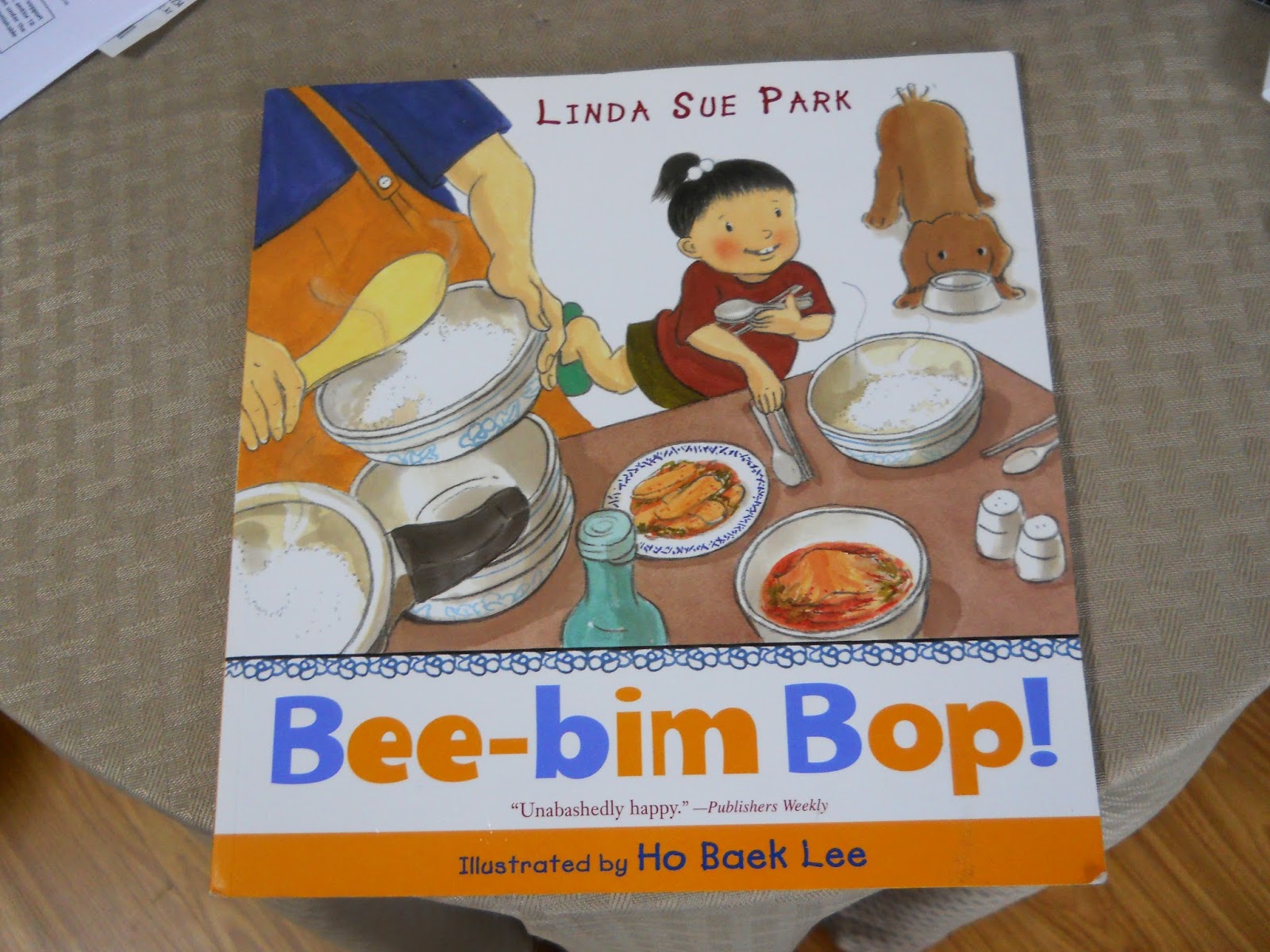
13. Bee-bim Bop! - Linda Sue Park.  A children's picture book in rhyme about a little girl who helps her mother prepare one of the most popular traditional Korean dishes. Fun for all ages.


Fiction


14. Your Republic Is Calling You - Young-Ha Kim.  A strange, yet compelling novel about a North Korean spy who has lived in South Korea for so many years that he presumes he's been forgotten.  He's settled, married, a father, has a career he enjoys, then one day, he gets the call to return to Pyongyang.

15.  I'll Be Right There - Kyung-Sook Shin.  This is Shin's follow-up to the wildly popular 2011 novel Please Look After Mom.  I haven't read it yet.  I have high hopes.

16. Three Days in That Autumn - Wanseo Pak.  A gynecologist at the end of her career finds herself conflicted about the ways in which she's helped women in the years after the Korean War.  This was my very first Korean novel; I was so excited to finally read some Korean literature.

17. The Chronicle of Manchwidang - Moon Soo Kim.  A father is obsessive about wanting to hang on to his ancestral home.  The son has other plans.  As usual, when generations are involved, it's never just a story about a family -- they represent different aspects of Korea -- in this case, old vs. new.

18. Drifting House - Krys Lee. For me, Krys Lee is THE definitive voice of Korean fiction.  In Drifting House, a collection of short stories, she reflects the people and culture, and they're real, not just convenient symbols for an allegory.  She probes, but she's got a light touch.  This is one of the best short story collections I've ever read.

North Korea

19. Escape From Camp 14 - Blaine Harden.  The true story of Dong-Hyuk Shin, who escaped from his birthplace, a prison camp in North Korea where Kim Seung-Il had ordered that his family be kept captive for generations.

20. The Aquariums of Pyongyang: Ten Years in the North Korean Gulag - Chol-Hwan Kang and Pierre Rigoulot.  I haven't read this book yet.

21. Nothing to Envy: Ordinary Lives in North Korea - Barbara Demick.  For this book, Demick interviewed in depth six former North Korean citizens who escaped to South Korea.  She explores what their lives were like there, and how they've adjusted to a markedly different culture.

E-Books on my Korean shelf

Our Happy Time (novel) Gong Ji-Young
Waxing Moon (novel) H.S. Kim
Under the Loving Care of the Fatherly Leader (nonfiction) Bradley K. Martin
Highway with Green Apples - (short story) Bae Suah
The Hen Who Dreamed She Could Fly (novella) Sun-mi Hwang
Korea: The Impossible Country (nonfiction) Daniel Tudor
The Living Reed: A Novel of Korea - (novel) Pearl S. Buck
Please Look After Mom - (novel) Kyung-Sook Shin
Angry Young Spaceman - (novel) Jim Munroe.  Technically, this book takes place on another planet, but it's easily recognizable as South Korea.)

Monday, June 16, 2014

Brother One Cell - Cullen Thomas


In 1993, a twenty-something young American woman fresh out of college and looking for adventure smuggled a bag of drug money through a European airport.  The transaction went smoothly, without incident.  A few years later, the police caught up with her, and she ended up serving a brief prison sentence.

 Almost a year to the day later, a young American man of 23 also looking for adventure, went on vacation to the Philippines and sent a box of hashish to himself (under an assumed name) in South Korea, where he worked as an English teacher.  Unfortunately, the post office smelled a rat and he was arrested on the spot.  After a swift trial (compared to the young woman's long legal drama), he began serving a full 3.5 years in the South Korean penal system.

If you're a fan of the book and/or TV show Orange is the New Black, you'll recognize that brief outline of Piper Kerman's (Piper Chapman in the show) story.  The second story might not be as familiar.  Brother One Cell, Cullen Thomas's memoir of his time as a prisoner in South Korea, is also a great read, and in some ways, even more riveting because of the foreigner/culture shock angle.

Possession with intent to sell would have meant possibly serving a life sentence, so Thomas convinced the prosecutor that he was an addict and it was for his own personal use.  In reality, he had been hoping to follow someone else's example and parlay his 300 (USD) Philippine purchase into 10K worth of sales in SoKo.  As mentioned above, his trial wasn't a long drawn-out affair, and within two months of being arrested, he began serving his sentence in Uijongbu, a city approximately 15 miles from the DMZ.  His cell was 10 feet long, 5 feet wide and 6.6 feet high.  He had a thin sleeping mat and two blankets.  A porcelain trough served as a toilet.

Prison meals consisted of barley, rice, kimchi and soup.  The prison had a store where the inmates could purchase extras, including ramen, which somewhat supplemented their meager fare.  There were also some attempts at making homemade alcohol using bread, juice and a plastic container.  The sticky rice served to them proved to be a handy glue substitute.

Since Uijongbu is pretty far north, winter was harsh in the unheated cell block.  One morning, Cullen found a rat frozen in a wash basin.  Rats overran the place, so work detachments of 15 men would corner them and bludgeon them with brooms. [Note: I actually got to see this technique for dispatching rodents one summer day while taking a bus downtown.]  After several months, he was transferred to Daejeon, a city located an hour south of Seoul.

Like Piper Kerman, Cullen Thomas was lucky in having friends and family that were supportive and sent him letters, pictures and books.  As a prisoner, he was only allowed one hour a day with a pen that he had to return to the guards.  A pen found in a cell was considered contraband, and could mean two months in solitary confinement.  Writing about his case or about the prison was strictly forbidden.  Cullen got around this by making notes on the backs of letters sent to him.. Since the letters had already been inspected when they arrived, they were never looked at again during inspections or during his transfers.  Pens were finally legalized, but only black ink.  Blue ink meant time in solitary.

Prisoners included gang members, political prisoners, draft dodgers, a painter, and other foreign prisoners.  Among the foreigners was Big Green, a mentally ill American who had killed his own children (it is a testament to Thomas's fine writing that he makes the reader feel sympathy for Big Green), Billy the Kid, a Columbian emerald and cocaine smuggler, and Tracey, a Pakistani gang member.

Among the Koreans, Cullen got along fairly well. He had picked up some of the language before he was arrested, and soon became fluent.  He played basketball, taught English, and worked hard to fit into the Confucian hierarchy, which was even more pronounced in prison.  Because of his knowledge of Korean, he was able to dissuade inmates that were close to his age from speaking to him in ban mal, or informal Korean.  He was worried that others might get the idea he was a subordinate, making him a possible target for bullying.

Also reminiscent of Piper Kerman's memoir, Cullen Thomas found work a respite from the boredom of serving time.  In Daejeon, he got a factory job assembling boots and shoes used by riot police, for which he was paid 600 won (59 cents) a day.

One of the most bizarre recollections in Brother One Cell involves the homemade penis enhancements that some of the Korean prisoners would do on themselves.  Cullen had noticed many misshapen and tumorous-looking chajees, and the men were happy to explain how they achieved this look:  They would make small cuts on the head and the shaft and fill the cuts with Vaseline, little pieces of plastic, or the bristles of a toothbrush.  They called these altered members "sunflowers" and swore that it drove women crazy with desire.

Cullen Thomas was made to serve every day of his three-and-a-half year sentence.  On the last day, he was taken to the airport and deported back to the United States.  He hasn't been back to Korea.  Brother One Cell was published by Viking in 2007 and translated into Korean the following year.  Like Orange is the New Black, it's a gritty coming-of-age story without a shred of self-pity.

Wednesday, April 23, 2014

A Blue-Hearted State of Mind

The sides of wet stones cannot console me,/Nor the moss, wound with the last light.

Empty chairs at empty tables.

I've been a truly blue-hearted bookworm this week because of the Sewol ferry disaster here in South Korea.  Like many other people, I'm heartbroken and outraged. My pendulum swings from disgust to sorrow and back again.  It's impossible to live in a country for a decade and spend that time working with the younger segment of the population and not be affected.  So many words have been said and written and will continue to be, but none will ever be adequate.

Wednesday, November 27, 2013

Dreaming in Literature: Robinson Jeffers, Page 201

I lie and hear dark rain beat the roof and the night-blind wind...

In my dream, this line of poetry was spinning around in my mind like the last sock in the dryer of the universe.  Where was this from?  Did I write it myself?  There's always a chance, right?  Of course the answer was no.  So who wrote it?  Robert Frost?  Nope.  Sounded like Robinson Jeffers.  I'd look it up.

Except I couldn't look it up.  I was working in an elementary school in South Korea, and there were no computers around.  There was a library.  I'd look it up there!  I gave my students a couple of pages to color and some coloring pens.  When they got to work, I tiptoed out of the room and ran down the hall to the library.

The library was nice, but there was no computer and the books all seemed to be in Korean.  I looked, and finally I found a book about American poetry written in English.  I looked at the index.  Robinson Jeffers.  Page 201.  I turned the pages to find a single sentence: "Robinson Jeffers was an American poet."  I put the book back and returned to my class.

I was trying to teach the children the song "Big Rock Candy Mountain", but I lie and hear dark rain beat the roof and the night-blind wind... kept going through my head.  As soon as I got off work, I'd run into the nearest internet cafe. This couldn't wait till I got home.  Actually, it couldn't wait another minute. I needed to go back to the library and look at that book again.  Maybe I'd missed something.

I told the students:  "I have to visit another classroom.  Keep singing, but don't sing "whisky" or "alcohol".  Sing "buttermilk" instead.  Be right back."

Running back to the library, I grabbed the book again and checked the index.  Page 201.  "Robinson Jeffers was an American poet."  I knew that!

Maybe it was someone else.  Emily Dickinson?  No, I lie and hear dark rain beat on the roof and the night-blind wind didn't scan to the tune of "The House of the Rising Sun."  It HAD to be Robinson Jeffers.  Robinson Jeffers. Page 201.

Someone told me that the principal was on his way to my classroom, and he was mad about the students being unattended.  I knew I had to get back, but I couldn't stop myself from checking  the book again.  Robinson Jeffers.  Page 201.  Robinson Jeffers.  Page 201.  Robinson Jeffers --

I woke up.  It was raining.

Sunday, November 24, 2013

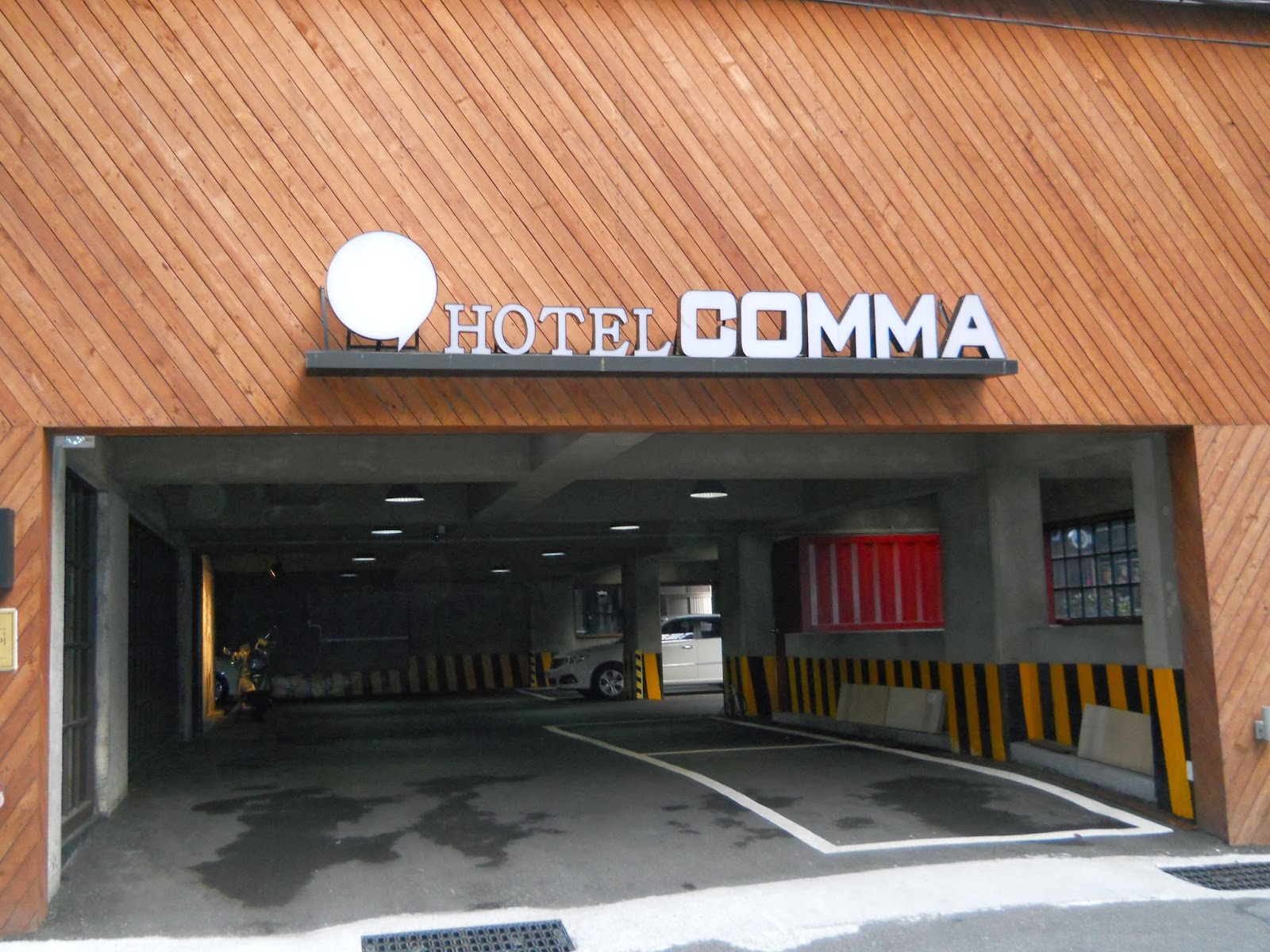
Hotel Comma


The "love hotel" pictured above is right around the corner from my apartment in Busan.  As a reader, as an English teacher, and as a lifetime comma abuser, I feel drawn to this place.  If it weren't so close to home, I would probably pause here.  One tiny criticism, though -- the comma in the sign looks more like a cartoon speech bubble.  Aldus Manutius would not approve.

Number of commas used/misused in this post:  5

Sunday, November 18, 2012

Cruel in Cheongju

Every time I visit my friend Teri in Cheongju, I always feel a bit of a sucker punch when we go downtown:

Notice the little satellite sign that helpfully reads "page 12".  What was I to think?  What would YOU think?


The first time I saw this, I was walking, yes indeed.  I was smiling, striding.  The theme from Chariots of Fire was crescendo-ing in my head, as were plans to move to Cheongju forthwith.  I rounded the corner smartly, looked past the coffee shop with an expectant smile and saw this:


My smile froze and fell.   I whipped through the five stages with a speed that would have impressed Elisabeth Kubler-Ross.

"A clothing store? No way.  The bookstore is probably upstairs, or around here somewhere. I just gotta look harder."

"What. The. Actual. Fuck.  Who in the HELL is responsible for this bullshit?  What kind of stupid idiot names a clothing store BOOK MARK???"

"Maybe there are some books about fashion inside. I don't mind; I can read about fashion, even if it's in Korean.  I really don't mind."

"Why go on??????  What's the use???  Later on, I'll be hungry and I'll probably see a sign that says Cheeseburger in Paradise and it'll just be another superfluous clothing store that markets size 0 clothing."

"Sigh.  Book Mark.  It's a clothing store, sure enough.  Sad but true.  Where's my camera?"


How many other bookworms walking about in Cheongju have felt the sting of this cruel mockery?  I guess it's mean and petty to hope that all of Book Mark's shoppers are merely of the window variety, but I can't help it.

Sunday, September 30, 2012

Escape From Camp 14

Shin Dong-Hyuk (right) and interpreter Yoo Hui -Jin at TOZ in Jonggak, Seoul, September 22, 2012

On September 22, I had the privilege, along with approximately 40 people from in and around Seoul to have the opportunity to meet Shin Dong-Hyuk, who is the subject of the nonfiction book Escape From Camp 14 by Washington, D.C.-based journalist Blaine Harden. The book was published earlier this year.  The event was sponsored by 10 Magazine Book Club.  (10 Magazine is a publication that is geared towards the expatriate community living in South Korea.)

 Shin, who was born in North Korea's  Camp 14 in 1982, was the child of two prisoners.  With no knowledge of the world outside of Camp 14 (including North Korea's deification of Kim Il-Sung and Kim Jong-Il), Shin grew up under hellish conditions.  Early in 2005 at the age of 23, he crawled under the electrified fence that surrounded the camp and escaped, making his way to China and then following year into South Korea and eventually to the United States, where he worked for a non-profit organization that aids North Korean refugees.  He is the only known person to successfully escape from one of these 'total control' camps.

At this time, Shin Dong-Hyuk is back in South Korea.  He travels around Korea and the world, telling his story and campaigning for the international community to investigate human rights violations in North Korean prison camps.  As Blaine Harden observed in his book, Shin is extremely handsome, and he looks much younger than his 30 years, which is surprising, given his life of hardship.  The years of malnutrition, neglect and overwork show up in his physique.  He is only about 5-and-a-half feet tall and looks to weigh somewhere around 125 pounds.  His legs are slightly bowed.

Speaking through an interpreter, Shin opted to turn his allotted speaking time into a question-and-answer session, inviting the audience to ask him anything.  Since most of the attendees seemed to have read Escape From Camp 14, they steered away from questions about his painful past and asked instead about his adjustment to a life of freedom, places he has traveled to (He said that Norway was the most beautiful place he's seen so far) and the international community's response to his experience.  One of the attendees asked how she might make her government aware enough to address the human rights abuses in North Korea.  After a brief hesitation, Shin said, "I don't know.  I don't have the answer for that."  He indicated that getting the world's attention has been slow and frustrating.  "Important figures keep telling me that they need evidence.  I remind them about the Holocaust."  He did say that in the past six years, "There has been some change.  It's slow, but things are changing."

Although he didn't discuss how he's been affected by his experiences in the prison camp, there are clues.  When someone asked him what books inspire him, he said that he doesn't read (he *is* literate; the children born in the prison camp were required to attend school) and he "can't really respond to books, movies and music".  He said that his friends have taken him to noraebang (singing rooms, karaoke) and tried to get him to sing, but he can't.  The years of hunger seem to always be with him as well.  Talking about a recent 3-day trip to southern California, he half-joked that he had a huge regret that he didn't have time to stop and eat at In N Out Burger.

When asked about his future plans, he said, "It's my destiny to tell about my life and my pain.  I'll tell my story until I die."  Hopefully, prison camps like the one he was born and grew up in will be eradicated long before that time.

Here is an interview in which Shin Dong-Hyuk discusses his life in Camp 14.


Thursday, August 23, 2012

Come Back To The ROK, Linda Sue, Linda Sue

Linda Sue Park at the 2007 Texas Book  Festival.  Isn't  her book cardigan fabulous?

A couple of months ago, right after I saw Krys Lee speak about Drifting House, My friend Pieter and I shared a taxi from Itaewon back to Seoul Station with a middle school guy.  This student, Landon, had made a point of coming quite a distance unaccompanied to see Krys Lee.  My own middle school self would have yearned to go, but would have been too intimidated to go see a real-live author, so Landon really impressed me.

Landon is Korean, but spent most of his younger years in Canada, so he's native-like in English.  I started babbling at top speed about how great it is to meet authors, they are my rock stars, etc.  Landon asked me how many I'd met.  I said that  Krys Lee was my third author.*  He wanted to know who the other two were.  I said Tobias Wolff and Larry McMurtry.  Landon didn't know those authors.  I briefly explained.

Then Pieter asked Landon if he'd met any other authors.  Good question.  It would never have occurred to me to ask.  I mean, this is a middle school kid, right?  I'd been planning to ask Pieter how many authors he'd met, but I confess that I would have skipped over Landon with nary a thought.  Sometimes I fear that I'm turning into the sort of asshole adult I held in contempt as a child.

Landon said, "A writer came to my school last year.  I can't remember her name, but she wrote a book called A Single Shard..."

I gasped.  "OH!  MY!  GOD!  LINDA SUE PARK!  YOU GOT TO SEE LINDA SUE PARK."

Landon said, "Yes, that was her name."

"I LOVE LINDA SUE PARK!"  I tried to take the squee coming out of me down a notch.  The taxi driver was looking worried or pissed, or both.  "I love her!  I love A Single Shard!  I teach her books!  In my Children's Lit class!  She was here?  In Seoul?"

Landon clarified that it was an international school in a city very close to Seoul, and not too far from where I now live.  Same subway line, as a matter of fact.

"Oh!  I want to meet her!"  I could feel myself wanting to behave in a way that would make me seem much younger than Landon.  I was on the verge of howling and throwing a tantrum like the one I threw at the age of six when my parents went off to the movies to see Bonnie and Clyde and left me with the babysitter:  But I looooooooove Bonnie and Clyde!  I have to go with you!  I won't be scared of all the blood, I promise!

A few hours later, I was finally home from Seoul and could smite my forehead in peace.  I had known for a while that Linda Sue Park had a web page, but I'd never visited it.  I visited it right then and there.  Surprise!   She has a blog, too.  I scrolled down, down, down and finally found this entry.  

The forehead-smiting began in earnest.  February!  My vacation month!  What was I doing?  I really don't remember, but I'm almost positive that it rhymes with "duck call"!  Hundreds of hours of messing around on the internet in my pajamas and I never once thought of going to Linda Sue Park's page.  One lousy little click.  One measly little subway ride and I could have seen her and told her how happy I am that I discovered her books and thank her for writing them.

Come back to Korea, Linda Sue Park.  Please.  If you show up in Korea during the winter again, I'll slide up and down icy mountains on my backside just to meet you.  If the semester has started, I'll beg one of my coworkers to substitute for me.  I'll even cut work, as a last resort, or bring all the English majors with me on the subway.  Since I've been reading your blog regularly now, I know you're off to Australia and Indonesia.  Have a great time...and maybe you could consider a side trip here?


*Not an accurate count.  In my excitement, I forgot William Stafford, Joseph Bruchac and Harlan Ellison.


Tuesday, April 19, 2011

2011 Pulitzers: New Kid On The Shelf


Warmest congratulations to Jennifer Egan for winning the 2011 Pulitzer fiction prize for her novel, A Visit From The Goon Squad. I'm really looking forward to finding this book, reading it and adding it to my Pulitzer pile. I'm so torn. Should I order it online or cruise the bookstores until I find it here in Korea? These are the kinds of geeky decisions that make life enjoyable.


.

In the last hours before the announcement, I had reluctantly abandoned my first choice, Freedom by Jonathan Franzen because I had become firmly convinced that The Surrendered by Chang-Rae Lee would win. This is as close as I've ever gotten to being right about the Pulitzer -- Lee's book was also nominated. Now that it's out in paperback, my plan is to talk it up as a choice for either Bookleaves or Cracked Spinz.

Monday, November 01, 2010

Oh Yes


I was searching through some old emails for my son's address written in Hangul, and found this message that he sent me last summer:


I heard of a quote by a Korean patriot, Ahn Jung-Gun.
He said, "Not reading a book, even for a day, makes me sick."
I though you would like it.
.
According to Ahn Jung-Gun's Wikipedia page, Ahn also wrote: "Unless reading everyday, thorns grow in the mouth."
.
Although my own response to a nonreading day is a moderate case of crankiness, I completely understand his sentiments.

Saturday, April 10, 2010

Readathon: Hour 10

Pages read: 48
Snacks: Lots of water this hour
Blogs visited: 5

I finished the book about Yi Sun-Shin. Incredible guy. Action-hero tough: When he was 28, he went to take his military exam. In the middle of the exam, he fell off of his horse and broke his leg. He braced himself on the good leg and quietly splinted and bound the broken one with a branch from a willow tree. If I gave this book/this national hero a song as is suggested in one of the challenges, it would be I Won't Back Down by Tom Petty.