Showing posts with label history. Show all posts

Thursday, August 04, 2022

July, 2022: Reading. Seriously.

 Another Val story before we begin. This was one of her favorites. Every time it popped up in her Facebook memories, she'd repost it.

Val was moving yet again during her time in Korea. I was not particularly pleased because she would be moving out of my apartment building and over to a university way the hell out in the country and about 30 minutes away by train. Although I was dreading the day, I got caught up in the hustle and bustle of her packing.

About 9:30 pm, she decided that she would load some boxes into the boot of her little red Matiz automobile. Of course the boxes were terribly heavy, so she decided that we must get a trolley.

A what? I said.

A trolley.

I decided that she meant a dolly, but didn't say so. 

We looked around in the dark stairwell on the first floor for a trolley/dolly, but didn't see anything. Finally, we ran into a security guard. He didn't want to speak to us because of the language barrier, but Val neatly cornered him at the door of his guardhouse. She pulled out her phone and started typing into the translator.

She showed the guard the word on her phone and then said in Korean, "Please give me."

He looked at her like she was crazy. She nodded. I nodded, too. Finally, he sighed and got his flashlight and looked around in the hallways of our building. We followed. Then after a decent interval, he shook his head and started back to the guardhouse.

"Wait!" Val showed him her phone again. "I KNOW they have trolleys in Korea. I've seen them."

Dolly was trembling on the tip of my tongue, but I confess: Even though English is my native language, I've always had an inferiority complex about speaking American English around English English speakers. I usually throw in the linguistic towel and give Brits the win right away.

The guard sighed, mumbled something and repeated the walk, shining his flashlight up and down the corridors. Then he headed back to the guardhouse and settled in with his K-Drama. He offered up a final word in English: "Impossible."

We retreated to Val's apartment. "Maybe there's another word," she said, looking at her phone. "Oh, hold on. Uh-oh. Look." She showed me the phone. Turned out that her finger had landed on the wrong word, and we'd had the guard looking around in the gloomy stairwells for a troll.

I was really really glad then that I'd restrained myself from saying dolly.

"I'll try again tomorrow," Val decided. "If he'll even speak to me. The poor man."

***

1. What Are Castles and Knights? - Sarah Fabiny. Nonfiction.

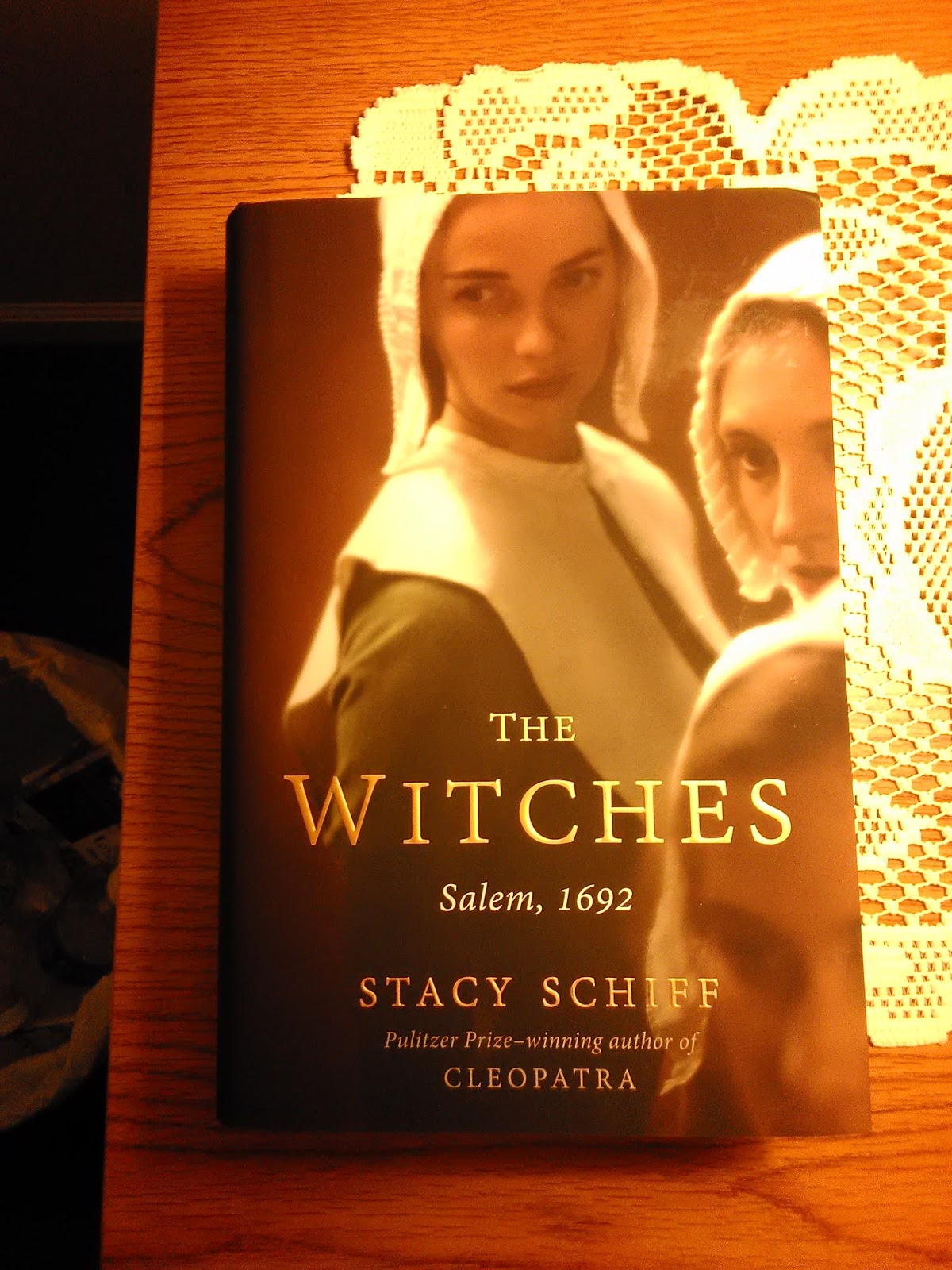
2. The Witches - Stacy Schiff. Nonfiction. Schiff takes the reader into the world of Salem Village, 1692 to make us understand the time and place that created a toxic atmosphere where nearly everyone lost their damn minds and sent 19 innocent people to their deaths for witchcraft based on the word of a few shrieking teenagers. By the end, I felt claustrophobic and a little crazy, but mightily enjoyed counting up the many references to The Wizard of Oz that Schiff cleverly inserted.

3. The Poisonwood Bible - Barbara Kingsolver. Novel. I shied away from this book for decades, and now I'm a little mad at myself, but not too much because I think maybe I just wasn't ready for this story of religion, culture clashes, and revolution (of all kinds) in the Congo (now Zaire) in 1959. It's a searing and illuminating book and Kingsolver's masterpiece. I am adding it to my favorite reads of 2022.

4. Who Was E.B. White? - Gail Herman. Nonfiction.

5. What Is the AIDS Crisis? - Nico Medina. Nonfiction. A careful, comprehensive look at the AIDS crisis from its very beginnings. The government's indifference was chilling, and Nico Medina pulls no punches. No bullshit. Well-executed.

6. Long Walk to Freedom - Nelson Mandela. Nonfiction. I audiobooked this one. Danny Glover's narration was interspersed with African national songs, crowd reactions in real time to events unfolding in apartheid South Africa, and speeches read in Mandela's own voice, which made for a moving listening experience. Since this was significantly abridged, I don't feel as if I got all the nuances or even the whole story, but the crux is there and it left me in a thoughtful mood, eager to learn more about Mandela and the ANC and the struggle for a more democratic South Africa.

7. Who Was Ponce de Leon? - Pam Pollack and Meg Belviso. Nonfiction. MAD RESPECT for how this book was written! It starts out like a conventional biography of Ponce de Leon, conquistador in the making, then it makes a wicked left turn that nearly had me scrambling for the Dramamine, and it essentially says: You know what?! This guy, none of these guys were heroes. None of them were admirable. They ruthlessly rode roughshod over native lands and territories and ruined millions of lives. They disrupted cultures. They enslaved and murdered people with weapons and disease! Then the authors take a tiny step back and allow that maybe Ponce de Leon couldn't help it; he was conditioned at an early age to believe that as an agent of Catholic Spain, he was on the side of right. Then they gather themselves again and they're like, nah, he's still awful. And that cute Fountain of Youth story? What a bunch of hooey cooked up to make him look deluded at worst and whimsical at best. 

o
p
s
e
o
t
S
r
dI read 7 books in July. When I wasn't Who-Was-ing, I felt as if my reading had unexpected depth. Am I being and becoming? Is it just a stage I'm going through? Actually, two of the Who Was...? books I read went way beyond my expectations (What is the AIDS Crisis and Who Was Ponce de Leon) and handled the material in a manner that would create new levels of understanding in mature readers while introducing it to newer, younger reader1. What Are Castles and Knights? - Sarah Fabiny. Nonf

Friday, January 31, 2020

The DNF Files: Medieval Tastes


I'm kicking off 2020 with a DNF. After struggling for a while, I finally threw in the bookmark.

Admitting defeat was difficult for several reasons: I purchased Medieval Tastes: Food, Cooking and the Table by Massimo Montanari, a very attractive trade paperback back in 2018 and paid a lot of money for it. I was so sure I would enjoy a scholarly jaunt through the culinary Middle Ages that I plunked down $30 without blinking.

Medieval Tastes is just not to my taste. It's that kind of academic writing that feels airless and claustrophobic, and it's a translation.  Every paragraph feels torturous. The content seems interesting, but I'm not sure because I was hacking my way through the print equivalent of brambles.

As always, I question myself: Am I just dull, or undisciplined? Shouldn't I relish (ahem) some rigorous reading? After stewing (sorry) for a while, I put the enjoyment criteria to Medieval Tastes. There are books you enjoy reading, and there are books that you enjoy having read. I wasn't enjoying it, and if I could make it through the book, I doubt that I'd have that warm glow of satisfaction from hard work.

Ciao, Medieval Tastes. Mi dispiace molto.

Friday, May 25, 2018

If The Book Isn't There, I'm Not There

Where am I? Doesn't matter; I've got a book on the go. Here's what with me right now:

At home:

The Collected Letters of Sylvia Plath - Sylvia Plath. This one doesn't get much farther than the patio because it's heavy. 1400 + pages. Four-and-a-half pounds. Not easy to read in bed or in the recliner. My best spot is at a desk or table where I can lay the book. I've had it for a little over a week and it's already showing signs of wear and tear...well, not tear. More like splash from a frozen strawberry lemonade. As for the contents, it's fascinating to read Plath unedited. Even the seemingly minor details.

A Book of American Martyrs - Joyce Carol Oates.  I've only just started this book. I keep it on the table in the kitchen, reading bits while waiting for coffee to brew or toast to pop up.

In my purse:

My Kindle. I started Tess of the D'urbervilles, but I'm stalled. I think it's because I know I'm going to be furious with all the men in Tess's life.

A paperback copy of The Optimist's Daughter by Eudora Welty.  Of course there must be a paper book if something were to go wrong with the Kindle, right? I had to find a skinny book. My new purse is a lovely gift from my mom, but it is narrow at the opening and widens towards the bottom. It's a triangle! Not the best shape for toting books around, but that makes me more creative about finding my reads.

In the car:

My current audio book, Destiny of the Republic: A Tale of Madness, Medicine and the Murder of a President by Candice Millard. I like to find errands to run unaccompanied so I can enjoy listening to this book. The narrator, Paul Michael, is particularly good. He has a firm, resonant Midwestern timbre for the fated James A. Garfield, a fine, peppery Scottish accent for the restless genius inventor, Alexander Graham Bell, and a flat, whiny Snidely Whiplash tone for Charles Guiteau, Garfield's assassin who was both a master manipulator and batshit crazy. Author Millard has structured a compelling narrative within an elegant prose style that feels scholarly but doesn't feel overstuffed with research.

For future audio encounters, I'm hoping the new Stephen King book, The Outsider, as well as David Sedaris's newest Calypso, will be journeying back and forth to the grocery store with me soon.

Monday, November 02, 2015

Nonfiction November: Adding On


I didn't mean to add another book to my nonfiction November, but eleven is such a nice number. I immediately got in touch with my inner Edith Piaf.

Plus, Salem! Too much to resist.

Okay, I'll stop now. 

Tuesday, September 13, 2011

My Thoughts Be Bloody - Nora Titone


My Thoughts Be Bloody is an excellent book about Lincoln assassin John Wilkes Booth and the theatrical family from which he came.  Booth's older brother Edwin was the brightest star in the American theatre, and he and his infamous brother had a stormy rivalry.  Titone, through her superb research, suggests that this rivalry for their father's (Junius Brutus Booth, a brilliant Shakespearean actor from the 1820s until his death in 1852) shining legacy may have played a part in Lincoln's death. 

Edwin, older than John Wilkes by four years, was the more successful actor, and he didn't want any of the other Booth brothers (there was another brother, Junius, Jr.) encroaching on his territory.  He divided the country roughly along the same lines that it would be split into during the Civil War.  He took the cities in the north and east, leaving John Wilkes the south and the west. 

John Wilkes resented this treatment.  He was handsome, muscular and athletic, but he was also lazy and undisciplined.  Furthermore, he hadn't had the same training as Edwin, so his notices were more often than not very poor.  He left acting to pursue an oil scheme in Pennsylvania which failed.  After that, the always staunch Southern sympathizer joined up with conspirators against the president, then made that last appearance at Ford's Theatre.

Although John Wilkes Booth is the undisputed villain of the piece, Titone shows very clearly what forces shaped and warped him.  At times in the narrative, I found myself nearly cringing in sympathy for John Wilkes Booth.  Edwin Booth doesn't exactly come out smelling like a rose.  His grasping for stardom didn't leave a lot of room for family feeling.  He was obviously afraid that if he mentored his younger brother, that brother's fame might eclipse his.  Turns out that he was right, except it was more infamy than fame.

Nora Titone does a great job of showing not only what life was like for members of that profession during the 19th century, but also what was going on outside that rather claustrophobic atmosphere, and she also provides perspective with interesting sketches of the famous figures that both brothers came in contact with. 

My Thoughts Be Bloody includes several pages of photographs, copious end notes and a first-rate bibliography.  It is an enjoyable, informative read and a fresh look at one of the most terrible moments in American history.