Showing posts with label Pulitzer For Fiction. Show all posts

Tuesday, July 06, 2021

June, 2021 Reading and An Ambitious Plan

 Eleven books in June! That's a really good total for me. I must credit The Spawn, who checks out books I'm interested in on *his* card, then when I need them renewed, he encourages me to finish quickly. Okay, yeah his tone gets a little snotty, but who can argue with results?

1. The Underground Railroad by Colson Whitehead. Fiction. I audiobooked this one, and I'm so glad I did. The narrator of the book, Bahni Turpin, is a treasure. She also narrated the previous audiobook I listened to, The Hate U Give. I was totally invested in all these characters. I was continually making excuses to go to the car. (Car time = audiobook time) The Underground Railroad is dazzling. Brilliant. Historical fiction meets fantasy meets alternative history with nods to figures in popular culture. Whitehead's writing is ...well, I already said dazzling and brilliant. If you were here, sitting in my purple chair, I'd be shouting dazzling! brilliant! at you until you went and found your own copy or threw something at me. The Underground Railroad feels almost as if it should be a pop-up book. That's what it did to my brain.

2. Blitzed - Norman Ohler. Nonfiction. Translated from German, Ohler examines how the Nazis were into drug use. In fact, they were the ones who invented methamphetamine! From the late 1930s to the end of WWII, almost everyone from 18 to 80 was speeding into history. It definitely explains the rapidity of Hitler's army taking over Europe and striding on into Russia. Meanwhile, Hitler, who didn't smoke, drink or eat meat, was turned into an addict by his personal physician. There's also some not-surprising and disgusting information on how new variations on their pharmaceutical concoctions were tested on prisoners in the work camps. An eye-opening read! I'll never look at WWII the same.

3. What Is The Panama Canal? - Janet B. Pascal. Nonfiction. An educational, informative look at all the false starts and missteps as well as political machinations that went into the building of the Panama Canal. Again, Tim Foley's illustrations add to the narrative.

4. Who Was Norman Rockwell? - Sarah Fabiny. Nonfiction. Rockwell's not one of my favorite artists, but I firmly acknowledge his importance in American art history. The book was a bit of a snooze for me, mostly because of my marginal interest.

DNF Philip Roth - Blake Bailey. Biography. I read about 150 pages before giving up. Not sad. Not sorry.

5. The Four Winds - Kristin Hannah. Novel. I read this book quickly, because that's the pace Kristin Hannah sets for her readers. I wanted to love this book, and I didn't. The writing seemed flat. It was also heavy on the melodrama, which she really didn't need to employ in the bleak Dust Bowl setting. The 1930s characters have modern speech inflections, which took me out of the story several times. Speaking of the characters, they are either sterling good or bad with no redeeming qualities. Did I mention that it's a bit repetitive? A former lawyer, Hannah writes as if she's presenting a case for a jury trial rather than a nuanced novel for readers to absorb and enjoy.

6. What Is The Story of Alice in Wonderland? - Dana Meachen Rau. Nonfiction. I'll be honest: Even as a child Alice and Wonderland seemed like too much of a muchness. I'm a Dorothy and Oz girl. 

7. Hamnet - Maggie O'Farrell. Novel. The story of Shakespeare's family, set during the 1680s, during a time of plague, and in the years before, when Shakespeare met Anne (Agnes, in this novel) Hathaway, who herself is a remarkable literary creation, as captivating as anything The Bard could have penned. I shied away from this novel for almost a year, and now I'm in equal parts mad at myself for doing so and thrilled that I finally read it, thanks to my book comrade, Care. Hamnet is haunting and mesmerizing. I would love to experience it as an audiobook. Believe the hype.

8. Who Is Ken Jennings? - Kirsten Anderson. Nonfiction. This is one of the short entries in the Who Was...? series, that number around 50 pages. Not a fan of the shorter books. They feel like filler. They feel like the book reports you do in 5th grade. I feel affection for Ken Jennings, dating back to his original 74 game winning streak. I appreciated the sidebar bio of Alex Trebek, but c'mon people! Give Alex his own full-length book!

9. Me and Patsy Kickin' Up Dust - Loretta Lynn. Memoir. To read a Loretta Lynn memoir feels like sheer love, because she's basically talking it. Her Kentucky cadences jump off the page. You can hear her voice. In this one, she discusses her friendship with legendary singer Patsy Cline, as well as her life and career around this time (early 1960s). One of Loretta's twin daughters, Patsy Russell, who was named after Patsy Cline, co-wrote this book with Loretta.

10. Still Woman Enough - Loretta Lynn. Memoir. Okay, yeah, I fell down a Loretta Lynn rabbit hole (oh oh lol I just made an Alice in Wonderland reference after talking shit about it a few paragraphs ago) but there are much worse things. Still Woman Enough was written after Loretta Lynn's husband of 48 years died, and she was free to talk more frankly about their rocky relationship. And talk she did! The framework of this book is going back and revisiting the movie version of Coal Miner's Daughter and what they got wrong and what they got right, and what happened after Loretta and Doolittle rode off into the sunset at the end of the movie. It was funny, it was beautiful, it was heartbreaking. I can't believe I've had this book for years, maybe decades and only now just got around to reading it.

11. All the Light We Cannot See - Anthony Doerr. Novel. This was my second audiobook for June, and I have mixed feelings about it. I admire the author's reach and grasp and how he knows and knows and KNOWS so much about science, so much about everything, but the book felt a little too tight, a little claustrophobic. The back-and-forth structure of the book between the characters and the skipping around in time was sometimes annoying, but worked in my favor when Disc 9 had a scratch and didn't play correctly and I realized that I didn't miss much between Discs 8 and 10. I appreciated knowing how all the characters ended up (GO Marie-Laure!) but I was more than ready to exit the novel with two more discs to go. I'm glad that I made the decision to audiobook this one, because I think I might have DNF'd an actual paper copy.

An Ambitious Plan

I realize that I never got back to blog about Part 2 of my May, 2021 reading. Days and weeks went by and my relationship to what I read, even though I truly enjoyed it, was getting fainter and fainter, and I felt colder and colder towards the material. This delaying and the resulting feelings was a cause for concern. If nothing else, Blue-Hearted Bookworm aka Blob, is my online book diary! I don't want impressions of my reading to get completely lost. I can imagine my Future Bookworm Self cursing my Present BS.

 It doesn't take a fully loaded bookshelf to fall on me for me to come to the conclusion that I need to update more often so that I don't have to struggle to reconnect with the essence of my feelings for the book. So: I'm going to try to do updates on Blob once a week, or at least once every ten days. I think my impressions will be fresher, but the books will still have time to settle inside of me. Let's see how it goes.

Sunday, April 22, 2018

What I Talk About When I Talk About Reading

I tried several times, but couldn't get this post off the ground. After a great deal of cursing and sweating, I decided to ask myself questions.

Did you notice that you were wrong again with your Pulitzer Fiction prediction?
Yes. There needs to be a new word for my level of perennial wrongness; it's truly breathtaking.

How do you feel about how it all shook out this year?
After my initial surprise, I hied myself down to the bookstore to order a copy of Less for my permanent Pulitzer shelf as well as my immediate future reading enjoyment. Can't wait to read it!

How about that biography winner?!
GASP!  Prairie Fires! I was completely delighted, and my joy was compounded upon realizing that I own a hardcover first edition. When I first read the book, I was struck by the brilliance of the research, construction and writing. There was not a wasted page; the editing is top-notch as well. I'll be reading Prairie Fires again soon and pestering my fellow bookworms to follow my good example. So glad the enigmatic Pulitzer committee saw things as I did.

Have you read any Pulitzer fiction winners lately?
Aaargh. I read the 1942 winner, In This Our Life. Not my favorite. I had high expectations because I loved the movie version starring Bette Davis and Olivia de Havilland. This was a case of Hollywood improving on a book. The screenwriter took this bloated, analytical novel and using some sort of alchemy, got it in fighting trim. I understand why it may have won the Pulitzer, but it's aged badly.

What are you reading now?
A couple of weeks ago, I found a copy of Life Plus 99 Years by Nathan F. Leopold (of Leopold and Loeb infamy). Although it was an autobiography/memoir, the book seemed evasive. Dishonesty fairly oozed out of the prose. Of course it was written about the time Leopold became eligible for parole (Loeb was murdered about ten years after the pair went to prison), so he was writing with one eye on  a specific audience, casting himself in the best possible light. In the book, Leopold wrote about a visit from author Meyer Levin and Levin's plans to write a novel based on the murder case. Leopold went on to discuss the result, Compulsion (1956) in scathing terms. It was the only time in Life Plus 99 Years that his carefully constructed mask seemed to come off. Of course I had to read Compulsion, which is creepily good in that In Cold Blood sort of way although Meyer Levin lacks Truman Capote's delicate touch with the written word. I also checked out a detailed nonfiction account titled The Crime of the Century.

Do you plan to have fun, fun, fun! at the Readathon?
Yes! I'm so tired of missing the Readathon allllllll the time since I moved back to the United States. Plopping myself down somewhere reader-friendly next Saturday, I shall refuse to be moved. Unruly Reader is helping me to start out in fine style; she gifted me a copy of The Teammates by David Halberstam. I'll do an update or two here on Blob, but I'll mostly be doing quick check-ins on Twitter @susanandbooks and at Goodreads where I'm SusanInSedalia. I'll devote this week to figuring out the rest of my stack and snacks. Any suggestions?

Sunday, April 15, 2018

Pulitzer Prediction: Best of 2017 Fiction?

Tomorrow is Pulitzer Day, and as usual, I'm all a-flutter. Got that ceremonial feeling. Where's my evening gown and long white gloves? Where's my tiara? If I turn up the couch cushions, is there enough money for a trip to the beauty salon?

There's a spot on my Pulitzer fiction shelf carved out for the 2017 winner. What will it be? I have no idea. Actually, I never have any idea. That's what makes this so fun; the anticipation is heightened.

My prediction? For months, I've been staunchly backing Lincoln in the Bardo by George Saunders. I don't know how it comes across on the page -- if it could wow the enigmatic committee -- but as an audiobook, it knocked me out. I cried while listening to the book (which was awkward, because I listen to my audiobooks in the car) then I cried again while describing the book to a friend while we were at the drive-in. He passed me tissues and onion rings and looked alarmed. Thinking back, I sort of  feel like weeping again, so Lincoln in the Bardo...yes, please, please, please.

That being said, there are a couple of other strong contenders. If the following books won, I not only could smile bravely, I could unreservedly feel pleased for them:

Pachinko - Min Jin Lee. I absolutely lost myself in this multi-generational family saga of Koreans struggling to make a good life in Japan. I have a copy of this excellent novel and would be proud to move it to the place of honor on my bookshelf.

A Book of American Martyrs - Joyce Carol Oates. In this case, I'm thinking more of JCO than her novel based on the abortion divide in America. I wish that she could lose her bridesmaid status regarding the Pulitzer fiction prize. She should have won for Black Water back in the early 1990s. Maybe 2018 is her year.

Twenty-four-and-a-half hours until announcements are made. I can hardly wait.

Friday, April 07, 2017

2017 Pulitzer Prize for Fiction, Check Out My Prediction

The Pulitzer Prize for Fiction is something I look forward to every year. Since there are no nominations announced in advance, I dizzy myself with speculation: Will the committee go with a crowd-pleaser, or go delightfully obscure? A book that takes place on American soil or in another country? The possibilities are endless. I usually get it wrong, but I don't mind. A new book will soon be nestled on my Pulitzer Fiction shelf.

Here's my prediction for this year:


So far, this has been my favorite read of 2017.  This is the latest novel I'm pestering people to read:

It's 1917. After their hapless father dies, or goes to "the heavenly table" as he terms it, three brothers, Cane, Cob, and Chimney Jewett decide to ditch their downtrodden life and try their luck as bank robbers. They've been inspired by a beat-up dime novel called The Life and Times of Bloody Bill Bucket and although they know it by heart, they still refer to it while they're on the lam.  This is the starting point for their encounters with what seems like hundreds of other characters, including Ellsworth and Eula Fiddler, who have a son, Eddie, who may or may not have joined the Army to fight in the Great War...in Germany? Where's Germany? What's this war supposed to be about?

I don't know how Donald Ray Pollock kept this huge cast of characters and their crossings and interactions straight. Maybe a flow chart? A timeline? And what of his writing? He has a distinctive voice, but he also reminds me of the two Mac Daddies (Larry McMurtry and Cormac McCarthy). McMurtry because of the journey, and legend-building and the influences of the past, and the past and present bumping up against one another. McCarthy because of well, the journey again, and the sudden, sickening, ugly violence that pops up with increasing regularity. But Pollock is funny as well, and not above the occasional stupid joke. There's also a feel of Faulkner and Flannery O'Connor, but a cheerful Faulker or O'Connor. Finally, I was reminded time and again as I read of Canadian author Patrick DeWitt's The Sisters Brothers, which makes me think of Steinbeck, and yes, this is what fiction should do to you -- make you feel connected and woke. (Part of me wants to correct that to awakened.)

I finished this novel in early March, and I'm already ready for a re-read. Maybe audio this time. Read/Listen with me so we can talk about it. A LOT.

Did I mention how cinematic The Heavenly Table feels? I don't know if it could work on the big screen because there are so many characters, but if it does become a movie, I am there. I will even pay full price and forget to stand just so under the light in the ticket line so that my gray hair is shown to best advantage. Maybe a miniseries? That would work for me.

So that's my Pulitzer Fiction Wishful Prediction. I think my chances are pretty good this year. We'll know on Monday.

Many thanks to my friend Mary for bringing not only The Heavenly Table but Donald Ray Pollock to my attention.

Monday, April 18, 2016

Welcome To My Shelf

Congratulations to the newest Pulitzer fiction winner Viet Thanh Nguyen! I look forward to procuring The Sympathizer, adding it to my collection, and of course reading it in the near future.


Sunday, April 17, 2016

Pulitzer Fiction, What's My Prediction?

I have read almost no fiction published this past year, but I still have to guess. It's too much fun to miss out on. It's Pulitzer Day! Where's my party frock? Where are my book-shaped earrings? What about cake?

Without really knowing what I'm talking about, here are my two predictions (in no particular order:)


Whether one of these books or another up for consideration wins the fiction award, I'm looking forward to the announcement, then adding the winner to my Pulitzer fiction shelf.


The suspense is so gorgeous, with the always-added tension that the fiction committee might decide not to make an award this year, which happens from time to time.

Monday 2 pm CT can't come soon enough!

What's YOUR (probably much more knowledgeable) Pulitzer fiction prediction?

Thursday, November 19, 2015

Pulitzer Collection: Ten To Go!


I have been working seriously on my Pulitzer fiction collection for nearly ten years. After taking stock last week, I discovered that I only have ten to go to complete my set. Of course this collection can never truly be completed as long as there is a prize awarded, but once I reel in these final few, I'll bask in a sense of doneness for eleven months at a whack:

Middlesex. 2003.

Advise and Consent.  1960.

Guard of Honor.  1949.

Dragon's Teeth.  1943.

Gone with the Wind. 1937.

Honey in the Horn. 1936.

The Store. 1933.

The Good Earth. 1932.

Laughing Boy. 1930.

The Able McLaughlins. 1924.

Okay, back to Nonfiction November! 

Tuesday, April 15, 2014

Fiction, Fiction, Made the Right Pulitzer Prediction

Too bad there's no end zone in literature.  I need to do my victory dance.

You can't blame me for being a little giddy.  A couple of days ago, I predicted that Donna Tartt would win the fiction Pulitzer.  I'm a bit startled to be right; maybe I'm starting to get the hang of this after all these years.  Last year, I almost called it, but that was probably the Korean connection giving me a lucky half-guess.

I haven't read The Goldfinch yet.  I got these terrible buying twinges today when I woke up and heard the news, so I quickly sent a Facebook message to my spawn:

Me:  The Goldfinch!  Mother's Day!  Hint, hint!

Spawn: I thought you wanted Rainbow Rowell's book [Landline].

Me:  Oh, God...I'm torn!  Did you already pre-order RR's book?

Spawn:  No.

Me:  I'm trying not to order any books...Kindle or paper.  So difficult.

Spawn:  OK

Me:  xoxo


Sunday, April 14, 2013

Pulitzer Fiction, Making My Predictions

It's almost Pulitzer time again, and I hope things don't go the way they did last year.  If they do, it might just break my reading mainspring forever.  I can see myself on the subway, staring vacantly ahead, a bit of drool gathering...but no.  No. Things won't go that way again.  We will have a new Pulitzer for fiction.

Which book will I be adding to my collection?  As always, I can't just sit still in my fancy dress clothes, my hands neatly folded in my lap, waiting for the announcement.  No, I must predict; the compulsion is too strong.

I'm going with Canada by Richard Ford.  It's true that Ford won back in 1996 for Independence Day, but  in the past, the Pulitzer committee has honored authors more than once. Ford is solid. Canada was one of my favorite reads in 2012.


If Canada doesn't win, I won't be unhappy if The Orphan Master's Son by Adam Johnson gets the award instead.  I haven't read it yet, but I've heard nothing but good things, and it's got my endorsement because of the Korea connection.  If it's on their shortlist, I hope the committee wouldn't get all cringe-y and self-conscious about choosing a book that takes place in a country that's all over the news these days and decide to pass it up.


The awards will be announced at 3 pm on Monday, April 15, which is 5 am on Tuesday, April 16 for me because of the time difference.  I hope I can sleep.  I'll be excited and worried until I hear that a book has been chosen.

Thursday, June 21, 2012

My Fill of Phil


I'm never going to read Philip Roth again.  I don't care if he wins another Pulitzer.  If he does, I'll read the book by proxy.  I don't care if he appears to me in another anxiety dream.  I'm done.  If he passes away, I'll feel bad that I wrote this post, but only for a while. I'll deal with it.

Arrrgh, PhilipfuckingRoth.  I've been sweet and the most patient of readers, but American Pastoral was like the dentist's drill on a rotten jaw tooth.  Reading him feels like you're late for work and your shoes and purse and keys are being held hostage by a ranting lunatic in sad, gray underwear who has got both morning breath and a mean streak a mile wide.

I want my props though, because I read 5 of his books.  Five!  Spread out over more than a couple of decades.  My 20something, 30something, 40something, etc. bookworm self just never warmed up to him.  I'll never stop being mystified at those who are fans of his work.

These are the books I read:

1. When She Was Good.  I was attracted to this one because I always liked the "little girl with the curl" rhyme.  (Come to think of it, Philip Roth reminds me of that little girl.)  Lucy Nelson seems like a less dangerous version but equally intense version of Merry Levov in American Pastoral.  Roth seems to enjoy grinding her down in scenes with that sick-making husband of hers, Roy.  I got my copy from my aunt.  It had a purple dust jacket.  I can't imagine why she bought it or imagine her reading it.  I bet she flung it, and that's how I ended up with it and then on this multi-decade slog.  Thanks, Auntie.

2. Goodbye, Columbus.  Even when Roth was in his late 20s, he was a ranting old guy.  I loathed this book, especially the title story.  Why did it get so much praise?  There was something terribly wrong with the American reading public's taste back in the late 1950s. There were definitely some disturbing fissures. I cite this and also Atlas Shrugged as an example.

Almost-read:  Portnoy's Complaint.  I was in middle school, and I heard it was filthy.  Naturally, I wanted to read filth.  I grew bored, skimming and searching for choice passages.  I finally abandoned the book at the point where Portnoy was in the bathroom (masturbating, if I remember correctly) and his mom kept standing at the door, knocking and shouting inquiries about his bowel movements.

Almost-read:  The Breast.  I was in college, and trying to read *serious* modern American literature.  This was short (96 pages).  I could do it...or not!  Professor David Kepesh turns into a life-sized female breast.  I hadn't encountered Kafka yet, and I thought this was the stupidest thing I'd ever heard of.  Back onto the library shelf it went.

3. The Human Stain.  This is the only Roth book that I actually have some fondness for.  I decided to give it a try after reading Quicksand and Passing, both by Nella Larsen.  I was irritated that the story was filtered through Nathan Zuckerman, Roth's alter ego, but Roth was rocking the irony, and it worked for me.  Satisfied, I followed it up with a viewing of the 2003 movie version, starring Anthony Hopkins and Wentworth Miller as the older and younger versions of Coleman Silk, the man with a 50-year-old secret about his identity.  Gary Sinise was Zuckerman. (Can you love an actor, and that love is based almost solely on his eyebrows?) The whole cast was excellent, except Nicole Kidman seemed out of place.

4. The Plot Against America.  Flushed with success about The Human Stain, I was all ready to read Roth's alternate history in which Charles Lindbergh becomes president in 1940, rather than FDR getting a third term.  I was expecting something really great like Philip K. Dick's The Man In The High Castle, but Roth's view of events left me feeling flat.  He also rushed into a silly ending, like he'd gotten all cranky just as he was coming into the homestretch and needed a nap.

5.  American Pastoral.  This was the book Roth was pissed at me for not having read in my anxiety dream about him.  Still, several years went by before I finally read it.  The way it came about was that I couldn't decide which Pulitzer to attack next, so I wrote titles I hadn't read on strips of paper and had The Spawn, who was visiting for the weekend draw one out.  Thanks, Kid -- that's ten days of my life I'll never get back again.

Ugh, how did that thing get a Pulitzer?  I haven't felt so disillusioned since I flung Atlas Shrugged out the window back in 2005.  An interesting premise, but again, everything is filtered through Nathan Zuckerman, and that takes up a chapter or two before the novel gets properly started.  Properly raised daughter of a former high school athletic star and a former Miss New Jersey grows up to be a terrorist.  But first we've got to wade through the history of glove making.  A little goes a long way.  The day-to-day routine of raising bulls for breeding?  Oh, come on.  Maddeningly meandering.  And sex!  When Roth writes about sex, it's not earthy, like John Updike, or kind of jaunty like Larry McMurtry -- it's revolting.  I actually feel nauseated reading descriptions of sex scenes written in his crabby accent. Not only were they gross, they came off as a little perfunctory. A literary cold shower.  And what about that fork-in-the-eye ending that was like a half-assed Mobius strip?  I had to return to the beginning of the book and Zuckerman's plodding, which didn't improve my feelings for Roth.

So, anyway.  Like I said: All done!  No more Roth.  The closest I even plan to get to him again is by reading Leaving a Doll's House by Claire Bloom.  I know I will be able to relate.  We both have had our fill of Phil.

Monday, April 16, 2012

Pulitzer For Fiction: Please, Not The 1970s Again!

2012 Pulitzer for fiction:  No Award Given.


So. Not. Happy.  It's like those years when you're around a bunch of people that don't know that it's your birthday.  There's an emptiness, an echo.  I feel like I got out of bed for nothing.

The committee *did* come up with 3 finalists:  Train Dreams by Denis Johnson, Swamplandia! by Karen Russell and The Pale King by David Foster Wallace.  I won't say it's cold comfort, but mighty coolish.

This hasn't happened since the 1970s.  There was no award for fiction in 1971, 1974 or 1977.  What if the 2010s are the 1970s all over again?

No Award Given.  N.A.G.  Yeah, this is going to nag at me all year.

Sunday, April 15, 2012

Guess Again: The 2012 Pulitzer Prize for Fiction


Since I'm in the process of building a Pulitzer fiction collection, it's always exciting to see which new book will be chosen to join my shelves.  I'm not a very good guesser, but it's fun to try.  Although my gut is telling me to expect something richly ethnic, my baseball-shaped heart is leaning towards The Art of Fielding by Chad Harbach.  We'll know in a couple of days!

Sunday, May 08, 2011

Happy Mother's Day To Me, Happy Mother's Day To Me...


This is my Mother's Day gift from The Spawn. How did he know exactly what I wanted???


Tuesday, April 19, 2011

2011 Pulitzers: New Kid On The Shelf


Warmest congratulations to Jennifer Egan for winning the 2011 Pulitzer fiction prize for her novel, A Visit From The Goon Squad. I'm really looking forward to finding this book, reading it and adding it to my Pulitzer pile. I'm so torn. Should I order it online or cruise the bookstores until I find it here in Korea? These are the kinds of geeky decisions that make life enjoyable.


.

In the last hours before the announcement, I had reluctantly abandoned my first choice, Freedom by Jonathan Franzen because I had become firmly convinced that The Surrendered by Chang-Rae Lee would win. This is as close as I've ever gotten to being right about the Pulitzer -- Lee's book was also nominated. Now that it's out in paperback, my plan is to talk it up as a choice for either Bookleaves or Cracked Spinz.

Wednesday, January 26, 2011

Everything Edith


Bookworm Meets Bookworm has a great idea, and I'm in. This read-along starts on February 2 and goes until March 2. The Age of Innocence is the 1921 Pulitzer fiction winner, so this fits neatly into my reading plans.

Suddenly, I've got this longing for Everything Edith. My plan is to warm up for the read-along by reading Wharton's 1913 novel, The Custom of the Country. During the read-along I'll be inexplicably pining away for things that I don't actually want in my real life -- a pompadour, a bustle, an evening gown trimmed with lace and feathers and fur accessories.

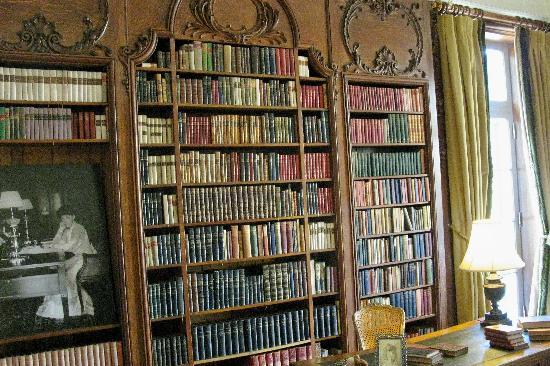
At least I can comprehend my gnawing within to be in possession of Wharton's biography by the absolutely brilliant Hermione Lee. Also, who could blame me for my desire to sit here and read? Gorgeous. I love the subtle grouping by color, but that one book leaning irks me a little.

Sunday, December 12, 2010

Bookstore Birthday #7


OK, I didn't get to a bookstore on my actual birthday, but because of the huge, gaping time difference, it was still December 11 in the United States (the scene of the crime 49 years ago) when I stumbled into What The Book? early this afternoon. So maybe I did have a bookstore birthday. You decide.

Birthday or no, I was pleased with today's score: A copy of A Fable by William Faulkner. No, Faulkner's not my cup of mint julep, although I wish I could appreciate him more, but A Fable is the 1955 Pulitzer fiction winner and has been an elusive little bugger. When I saw it, I pounced. Then I called Faulkner Guy. Well, I had to tell someone. I expected him to get all crazy and Yoknapatawphan on me, but he stayed pretty calm. Perhaps he's saving up the jubilee until work on Monday.

As for me: Squeeeee! A choice addition for my Pulitzer shelf!

Monday, April 12, 2010

Pulitzer Fiction: The New Kid On The Block


I've never heard of this novel, but I'm very much looking forward to acquiring it for my Pulitzer collection and reading it. That cover's pretty anemic, though.

This is what I like about the Pulitzers. Since we haven't got access to a nominees list, every year is a surprise and often, a fresh discovery.

NANOWRIMO types: Take note and take heart: Tinkers is apparently a first novel and Paul Harding struggled for several years to find a publisher.

Tuesday, March 30, 2010

The Way West


I finally got back to the Pulitzer Project with The Way West, the 1950 fiction winner by A.B. Guthrie, Jr. The novel, which takes place in 1845, features Dick Summers, a mountain-man-turned-farmer who was also a character in the prequel, The Big Sky. Summers reminded me a great deal of Woodrow Call from Lonesome Dove, except a little more gregarious. Strong and silent, Summers is the type of character we've come to demand in a novel about the west.

Summers is asked to lead a wagon train from Missouri (near Independence) to Oregon. His wife has just died of fever and he misses his mountain days, so he agrees. The hardships of the pioneers and their conflicts with one another are detailed, as is the vast country through which they travel.

The captain of the wagon train is actually a guy named Tadlock, who is full of self-importance and one putrid idea (shooting all the dogs on the wagon train, wanting to carry on business as usual instead of tending to a dying man) after another. Not too far down the trail, realization dawns on the other pioneers that Tadlock is ill-equipped to lead and Lije Evans, a likable giant of a man is elected to take over and grows in confidence about his leadership ability as he ably handles several life-and-death situations. He and Dick Summers also have a fine bromance.

I was surprised and delighted with Guthrie's flash of sly humor in the chapter where the all-male council of the wagon train gets together and debates whether it's right to ask the womenfolk to cook with buffalo and cow chips. It's a no-brainer because they're crossing the Great Plains and wood as a fuel source is in scant supply but there's still delicacy and formality amongst these rough and travel-weary pioneers. When one of the council, a man named McBee (who is the forerunner of what would one day be "trailer trash") dares to refer to the substance in question as "shit", the others recoil from him like characters in a Jane Austen novel.

Sometimes Guthrie's prose gets a little purply as he gets caught up in describing the scenery on the way to Oregon, but one can hardly blame him since the pioneers are seeing views they'd never seen before. Another tiny complaint that I have is that some of the characters are briefly introduced and followed then only seen again rarely, in passing. However, there are two sharply drawn minor characters. One is Curtis Mack, a philanderer who seduces then abandons the teenaged Mercy McBee. Mack is a spineless, gutless bastard but he knows he's loathsome and struggles mightily with his shame and guilt. The other is Judith Fairman, whose misery from being pregnant and on the trail increases tenfold to include grief and remorse when her understandably overprotective behavior contributes to her small son's fatal accident. By the way, the son's name is Tod, which is the German word for death. Coincidence or Guthrie serving up some grim humor?


My favorite thing about The Way West is the sun-baked (western version of 'hard-boiled') dialogue. Here's the taciturn Dick Summers talking about getting the wagon train across the treacherous Snake River: "It ain't easy, but it ain't beyond doing. We'll get it done."

The ending of the novel was the prose equivalent of the ending of one of those 1950s Cinemascope westerns with a big rousing triumphant narration of Lije Evans' thoughts as he gets his first gander at Oregon. One can almost hear the orchestra music swelling, blaring out Aaron Copeland and see the huge yellow leathery-looking letters of the end credits rolling. It came off a little forced.

I was expecting to like The Way West more than I did, but in retrospect, it might have been better to read The Big Sky and The Way West together as if the two books were one big story. I'm almost sure that Guthrie won the Pulitzer on the strength of both novels combined.

The Way West was made into a movie in 1967 with Robert Mitchum as Summers, Kirk Douglas as Tadlock, Richard Widmark as Lije Evans and a very young Sally Field (pre-Flying Nun) as Mercy McBee and was directed by Andrew V. MacLagen who directed Shenandoah (1965) which is one of my all time-favorites. Although The Way West received rather tepid reviews, I'm intrigued by that casting and would like very much to see it for myself.

Saturday, August 08, 2009

Miscount


Oooops. That was 27 books I hauled back from the States. Not 26.

The book I forgot to mention (Why? How?) is The Way West by A.B. Guthrie, who also wrote a prequel, The Big Sky, as well as the screenplay for the 1953 classic movie Shane.
.
The Way West is about settlers in a wagon train going from Missouri to Oregon. It's the 1950 Pulitzer fiction winner, and I'm pretty sure I'm going to enjoy it tremendously. The good vibes started back in that magnificent Barnes & Noble in St. Louis where I unexpectedly stumbled onto so many bookish treasures. [Insert dreamy reverie here]

I thought this novel had gone missing, then I found it in one of the many pockets on my suitcase. My sigh of relief turned to a sigh of annoyance as I realized that I'd hurriedly jammed the book into the pocket with some smaller items and accidentally creased the front cover. There's a sepia-toned photograph of a wagon train on the cover so the crease barely shows, but I can feel it when I'm holding the book. So irritating.

I've only paged through a little bit, but words and phrases keep attaching themselves to my eye. This one probably won't be on the TBR shelf long. From just a cursory look at the prose style, I wonder if A.B. Guthrie (1901-1991) was one of Larry McMurtry's influences.

Monday, June 22, 2009

Dreaming In Literature: Bookworm Prisoner


North Korea's military invaded South Korea before the United States military had a chance to come in and rescue all the expats, as planned. We all decided to make the best of it and thought maybe the North Koreans would want some English lessons as well.

Actually, the North Koreans didn't really care for anyone non-Korean being in the country and started coming up with any possible excuse to deport foreigners. Somehow they found my blog, got an eyeful and decided that what I read and discussed was in direct opposition to their philosophies.

Next thing I knew, the police were at my door in full riot gear -- sticks, shields and all. Since they looked as young as my students, I wasn't really worried. One of them even bowed a little and began discussing the problem with me in English that was pretty impressive. I praised him for his diligence about studying.

He waved off my compliment. "Your book list. It is unacceptable." He gave me a piece of paper. "This is our list of banned books. You have read eighty percent. Unacceptable."

Damn, I thought. I'm going to be deported. Crap. I never learned how to make kimchi. Why didn't I buy Good Morning, Kimchi! when I saw it at Kyobo all those years?

"When do I have to leave?" I asked. "You see, I've got all these books -- " I gestured at my shelves. "I need to get them home."

"You don't understand," he said. "Your reading list is bad, very bad! We are going to put you in prison. No deportation. Prison! Do you understand?"

"You mean like jail? Lock me up?"

"Yes. Our list and your list..." One of the other policemen had somehow found my reading journal on the top shelf, next to the Little House books. "This list is bad. You are going to jail!"

"How long?"

No response.

"When? Can I take a few things?" I'd grab the Pulitzers, if I could, but I had a feeling that the collection would be stalled for a while at 38.

"You go to prison tomorrow. Goodbye." He and the other police bowed and left.

I quickly called as many of my expat friends as I could and explained my situation. They instantly showed up at my apartment. Surprisingly, none of them had been singled out for this particular crime.

"I'm going to try to get all the Pulitzers in my suitcase. And my toothbrush. Screw clothing -- I bet they'll make me wear some ratty uniform."

"You probably won't have time to read," Diane pointed out. "I heard that North Korean prisons work you in the fields from dawn to night."

"Well, they can't work people twenty four-seven. I bet the prison library only has books in Hangeul. Will you guys send me some books?"

"No way." Talya said. "We might send the wrong ones and get thrown in jail, too."

"Good point." I sighed. "I should call my family. I can just hear them saying 'I-told-you-so.' I'll just act like it's no big deal. That way, they won't worry or have the satisfaction of being right."

"They already know," Shanna said. "Obama got on the news and said that he's sorry for you since he's a reader himself, but the United States can't give in to North Korea's unreasonable demands."

"Shit," I said. "Did you know that I voted for him?" Everyone nodded glumly.

.Leigh wanted to know if she could borrow The Zahir. "It's Paulo Coelho. Keep it forever," I told her.

The riot police showed up again at suppertime. "You go to jail now."

I lost my patience. "Now!? You said tomorrow! Damn it, these last-minute schedule changes are something that have gotten under my skin for years! I need to go to E-Mart!"

"Go to E-Mart, then come back here and go to jail."

Unaccompanied, I left the apartment and walked to the subway station. As I stood on the platform, I thought this might be a good time to make a run for it, but wait! My red suitcase (with all those Pulitzers inside) was back at the apartment. Damn.