Saturday, December 31, 2011

2011's Whole Damn Shootin' Match
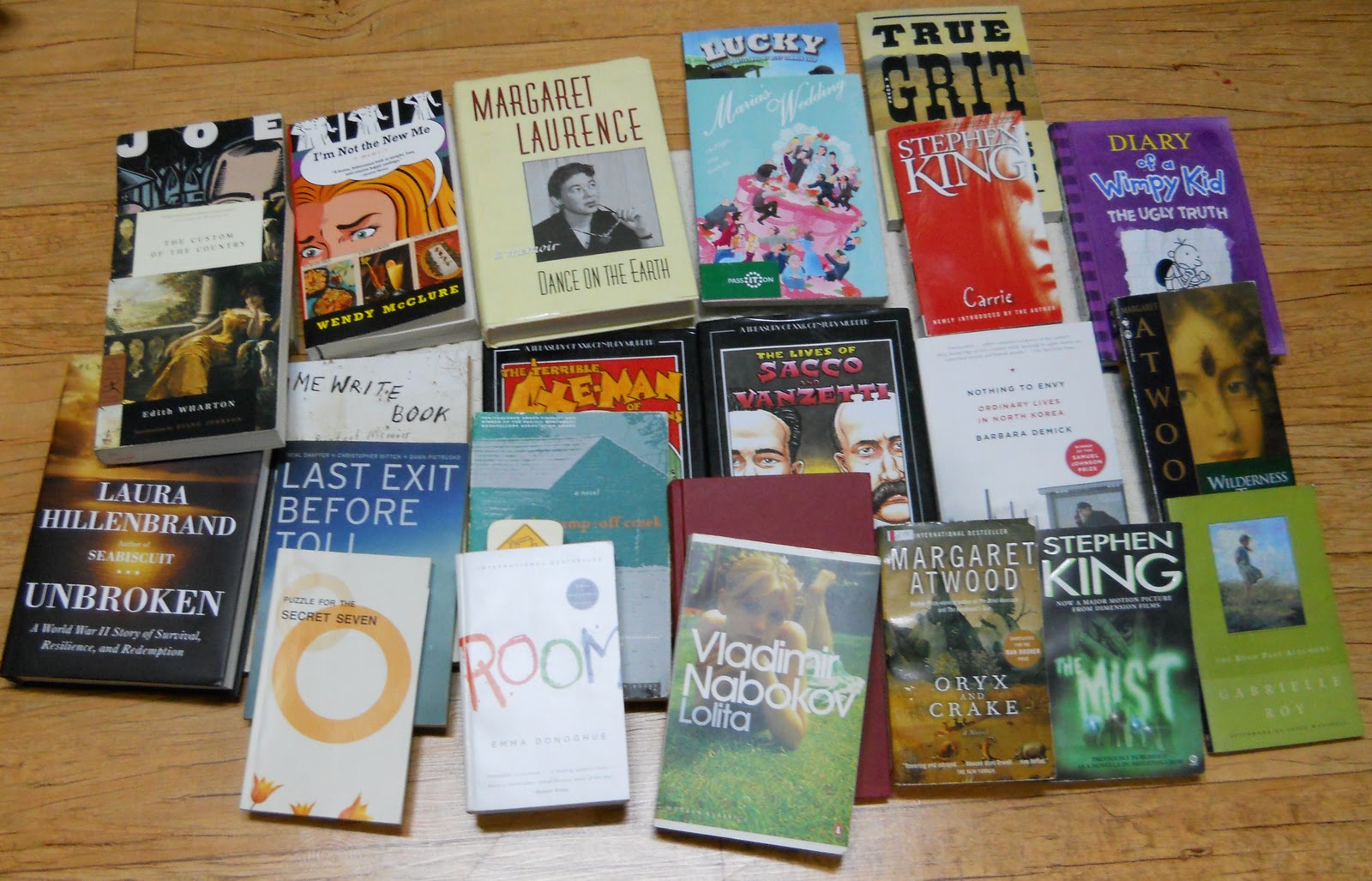
A few from Bybee's Class of 2011


Total number of books:
112


Pages read:
29,797


Average # of pages per book:
266 pages


Library books:
 9


Kindle/Nook books:  (New category this year!)
19


Fiction:
61


Nonfiction:
 42


Poetry:
 2


Audiobooks:
1


Graphic Novels:
 6


Book/Movie Experiences:
5 (I meant to have so many more)


Shortest Book:
I Have to Go! - Robert Munsch  (23 pages)


Longest Book:
A Prologue to Love - Taylor Caldwell  (725 pages)


Newest Book:
The Misanthrope's Guide to Life - Meghan Rowland and Chris Turner-Neal (September 18, 2011)


Oldest Book:
An Old-Fashioned Girl - Louisa May Alcott (1870)


Hit Me Baby One More Time (books I reread):
True Grit - Charles Portis
Charlotte's Web - E.B. White
A Farewell to Arms - Ernest Hemingway
A Prologue to Love - Taylor Caldwell
Carrie - Stephen King


Chunky Monkeys (books with 500+  pages) :
4


Skinny Minnies (books with fewer than 100 pages) :
15


Funniest Book:  
Me Write Book:  It Bigfoot Memoir - Graham Romineau


Saddest Book:
Nothing to Envy:  Ordinary Lives in North Korea - Barbara Demick


New Miserable Experience
(books I finished but didn't really care for) :
Rhett Butler's People - Donald McCaig
Memoirs of a Dutiful Daughter - Simone De Beauvoir
Little Men - Louisa May Alcott
Sarah's Key - Tatiana de Rosnay
Please Don't Shoot My Dog - Jackie Cooper
Joshua Then and Now - Mordecai Richler
The Piano Tuner - Daniel Mason
The Elegance of the Hedgehog - Muriel Barbery


Book I feel guilty for not liking:
The Last Lecture - Randy Pausch


There's Good in Goodbye (The DNF Files):
Three Generations - Yom Sang-Seop
The Criminal - Jim Thompson
A Terrible Honesty: Mongrel Manhattan in the 1920s - Ann Douglas
Passionate Uncertainty: Inside the American Jesuits - Peter McDonough and Eugene C. Bianchi


I'll Tumble 4 Ya  (books I really liked):
The Hunger Games - Suzanne Collins
Hitch-22 - Christopher Hitchens
Winter's Bone - Daniel Woodrell
The Custom of the Country - Edith Wharton
The Cariboo Horses - Al Purdy
The Tenderness of Wolves - Stef Penney
Room - Emma Donoghue
American Bee - James Maguire
Unbroken - Laura Hillenbrand
The Wilder Life - Wendy McClure
The Immortal Life of Henrietta Lacks - Rebecca Skloot
A Stolen Life - Jaycee Dugard
My Thoughts Be Bloody - Nora Titone
Are You Really Going to Eat That? - Robb Walsh
The Jump-Off Creek - Molly Gloss
The Sisters Brothers - Patrick deWitt
Joe - Larry Brown
Eden's Outcasts: The Story of Louisa May Alcott and Her Father - John Matteson


You From Around Here? (Author Nationality):
Belgium - 1
Canada - 16
England - 7
France - 3
Ireland - 1
Russia - 2
Scotland - 1
South Africa - 1
South Korea - 1
United States - 77


Male authors: 59
Female authors: 51
Co-authors: 2


Books written before 1800:  0
Books written 1800-1899:  4
Books written 1900-1960: 22
Books written 1961-1999: 29
Books written 2000-2011:  46


Pulitzer prizewinners:
4 (3 fiction, 1 biography)


Happy discoveries:
Wendy McClure, Patrick DeWitt, Meghan Rowland and Chris Turner-Neal and The Sheila Variations


2011 Challenges completed:
Paris in July
The Western Readalong
The Foodies Challenge
Edith Wharton Readalong
100+ Challenge

Canada Try:
4th Canadian Book Challenge 11/13.
Sigh.  No real maple syrup down the front of my Habs jersey.


Happy Book Year -- Time for some reading resolutions!

Thursday, December 29, 2011

Bridge Book


For the first time since December of 2005 (The Human Stain), I think I'm going to have a 'bridge book' -- a book that I start in one year and finish up in the next.

 It's Taylor Caldwell's fault.  My longtime literary crush on her suddenly burst into ardent flame over the holidays.  After polishing off A Prologue to Love, I found another of her books, The Wide House (1945) on my TBR and was compelled to begin it even though I had to go back to work the day after Christmas and The Wide House qualifies as a Chunkster.

Call it the grumblings of a fussy old bookworm, but bridge books annoy me.  I like to have the decks clear and everything counted up tidily for the old year and the new year ahead of me clean and bare, but shining with possibilities.  I have the same feeling when I have an unfinished book at the end of a readathon.

Although bridge books offend my OCD bookworm, the downside of finishing a book in the late hours of the old year is that the finish might come too early.  Back in 2008, I was aiming for my first triple-digit year.  I hit my dinger (Endurance) somewhere around 6 pm on December 30.  Basking in my triumph, I decided not to start another book until January 1.  Although you could count that time in mere hours, it felt interminable.  By 11 pm on the 31st, my fingernails were all bitten down and I was pacing around my apartment carrying Animal, Vegetable, Miracle.  As soon as the midnight fireworks were done, I cracked the cover.

Last year, I finished my book (Stuff) mid-afternoon on the 31st.  I flew from the US to Korea the following day, and by the time I settled in my airplane seat for the long flight, I was ravenous for the printed page.  I ran through The Best of Everything like pigs through the corn.

The beauty part of the bridge book seems to be that since a lot of the heavy lifting has been done in the previous year, a reader can hit the ground running and almost immediately begin posting stats for a new book year.  There's also not that aching withdrawal.  Some year though, I'd like to strike that perfect balance and finish a book just before the clock strikes twelve.

Friday, December 23, 2011

The DNF Files: Three Generations - Yom Sang-seop


From the book jacket:

Touted as one of Korea's most important works of fiction, Three Generations (published in 1931 as a serial in Chosun Ilbo) charts the tensions of the Jo family in 1930s Japanese-occupied Seoul.  Delving deeply into each character's history and beliefs, Yom Sang-seop illuminates the diverse pressures and impulses that drive them.  This Korean classic, often compared to Junichiro Tanizaki's The Makioka Sisters, reveals the country's situation under Japanese rule, the traditional Korean familial structure, and the battle between the modern and the traditional.  The long-awaited publication of this tour de force is a vital addition to the Korean literary canon available in English.

I'm terribly disappointed with myself for not getting along better with this book.  After about 50 pages, I thought it was meandering, and I chafed against its rhythms.  Maybe it's the book.  Maybe it's me. I don't know.  When I first found it, I was excited to be reading a Korean novel that was both literature and a slice of history.  This is in my DNF files, but  it may be a short stay before it goes back on the TBR.

Tuesday, December 20, 2011

Christmas Shopping Gone Wrong: A Prologue to Love - Taylor Caldwell (1961)


I had to wheedle and beg a United States member of Bookcrossing to send me her copy of A Prologue to Love a few years ago.  She didn't want to ship it overseas; I had to sweeten the deal by swapping a couple of fairly new books with her, the titles of which I've long forgotten.

So glad I did.  Whenever I'm in the mood for some comfort reading, A Prologue to Love satisfies like no other novel.  I've got it out again and am reading it.  Knowing the book so well, I can just dip in anywhere, and since it's nearly Christmas, I thought I'd  go to the scene that turns the main character into a miser and recluse for good.  She was already on the road, but the results of her unfortunate Christmas shopping trip gave it the final twist.

For those unfamiliar with this novel, A Prologue to Love (1961) is the story of Caroline Ames, the world's richest woman.  I believe this fictional character is loosely based on Hetty Green, a wealthy miser known as "The Witch of Wall Street.".

Caroline's beginnings are like something out of Dickens or Bronte.  Born sometime around 1860, she's growing up in extreme poverty in a town outside of Boston.  She's motherless because her mother got sick and her father was too cheap to call a doctor in time.  Caroline's father, a millionaire,  is always away traveling and he is revolted by her because she resembles his father, an artist who found fame only posthumously after keeping his own family penniless for years.  Caroline can't see that her father despises her.  She worships him.

Even though her father doesn't like her looks, he recognizes that she is intelligent, and begins a systematic training to make her a miser like himself.  He starts with fear, telling her that people with no money are no better than stray dogs and deserve, like the dogs, to be laughed at and kicked away.  He tells her that she must not spend any money.  She must save it against that eventuality.  John Ames doesn't let her in on the fact that he's one of the richest men in the world.  Naturally good and noble, Caroline begins to grow sullen towards her other relatives and her friends, who are alarmed at what her father is doing to her.

Now living in Boston with her father and her aunt, Caroline realizes that for the first time, it's permissible to exchange Christmas presents.  Her father frowned on it all her life.  Caroline makes a plan to go Christmas shopping.  Mindful about getting the most for her money, she makes a plan to take the horse-drawn streetcar to the low-rent side of Boston and shop for gifts at a store there that she frequented with her beloved nurse and housekeeper when she was a child.

While Caroline is in the store, engrossed in picking out items from the rather shoddy stock, her purse strap is deftly cut from her arm by a thief.  Noticing that it's gone, she believes that she left it on the streetcar and starts to run out the door with the would-be purchases still in her hand.  The store cop thinks she is one of many shoplifters that he sees on a daily basis, and pulls her back in the store.  When she struggles, he slaps her.  Then the cop notices that there's something different about her, even though she's dressed in ill-fitting and shabby clothing like most of the other customers.  He drags her back to the owners' office, and they interrogate and abuse her, saying that she's probably a whore because her hands aren't rough from menial labor.

Caroline tells her story about losing her purse and they laugh at her.  She's too rattled to ask for a messenger to be sent to her aunt's home on Beacon Street, but the store cop grows more uneasy because he's noticed that even though she's scared, she's sporting an upper-class accent.  She looks well-fed, her hands are smooth and her hair is clean and fixed neatly.

Finally, Caroline convinces them that she's telling the truth and the men all have an "oh shit" moment.  Since she's young (about seventeen), they cajole her into believing that it was all a misunderstanding and no hard feelings.  They give her the cheap crap for free and have her sign a paper (which she doesn't read because she's too upset) promising not to hold them liable for anything.  They send her home in a hired hack, and the driver pulls up to the servants' entrance.  Too intimidated, she waits till he drives off then creeps around to the front door.

Her aunt finds Caroline in her bedroom, still in her hat and coat, shaking.  She figures Caroline got a chill, then when she finds out that Caroline lost her purse, she shrugs off the lost seventy-five dollars.  The girl won't confide in her -- or anyone, till much later in the novel -- but the shrewd and observant aunt notices after that day, Caroline begins dressing a a little bit better and carries a purse with a stout strap in a stranglehold grip all the time.   More than her father's corrupt teachings, this Christmas incident will inform the rest of her life.

I absolutely love this book.   It should be made into a movie, or even better, a miniseries.

Wednesday, December 14, 2011

Canape Reviews

mantinga.co.uk  So yummy and so clever

I don't know about you, but I could live on canapes.  If I were stinking wealthy, I'd hire a chef or two that had majored in hors d'oeuvres at Le Cordon Bleu or wherever and give them orders to keep 'em coming.  Breakfast lunch and dinner.  Savory and sweet.  Kistchy offerings to amuse me, featuring that nacho-flavored cheese in the aerosol can.  Retro nibblings, like mini pigs-in-the-blankets and devilled eggs for that Proust-y side of me.  Healthy bites, like baby vegetables for when I'm feeling Puritan and austere.  Appetizers from abroad, so that I might feel all smarty and pleased about the expatriate side of myself. And of course, canapes shaped like triangles, because that's my favorite food shape.

I should never try to write a blog entry when I'm really more interested in food entry.  Anyway, here are some morsel-sized reviews of books I've read lately.  It embarrasses me slightly to admit that they began life as Facebook statuses, but I rearranged them on a silver-plated tray and added some garnish.  Enjoy!

The Mist - Stephen King. A short novella that was originally part of Skeleton Crew. After a summer storm, a heavy mist descends across Maine, and there are eely tentacled monsters in it capable of destruction on a large scale. Townspeople trapped in the local food market wonder if it's an army experiment gone way wrong. I've always been rather fond of foggy weather; now I'm not so sure. Looking forward to downloading the movie version, which was directed by Frank Darabont, who has also directed other works by King, including The Shawshank Redemption.

Darkness Visible - William Styron. Short memoir of Styron's bout with depression back in the mid-80s. A little sparse, but even brief encounters with depression should be recorded, since it's a sneaky disease that is still difficult to understand.  Styron's labyrinthine sentences are so beautifully structured.

Three Men on the Bummel - Jerome K. Jerome. Sequel to Three Men in a Boat. Ten years after their trip down the Thames, George, Harris and J. decide they need a bicycle trip in the Black Forest. Starts out hilariously (I'm positive that Robert Benchley was influenced by Jerome -- that sly befuddled style) but turns into a travelogue then goes off the rails on a crazy train and becomes a critical analysis of the German people. Hugh Laurie read this on the BBC back in 2002, so I tried to imagine his voice. It got me over the rough spots.

I'm Not the New Me - Wendy McClure. After an unpleasant encounter with a photo of herself doing karaoke in Las Vegas, Wendy hies herself off to Weight Watchers and starts an online journal about her weight-loss called Pound. It's not the typical weight-loss memoir; Wendy doesn't feel comfortable being an inspiration for others. Frank, humorous, and thoughtful. The vintage WW recipe cards are a hoot.  Read this one as well as her most recent book, The Wilder Life.
 

Last Exit Before Toll - Neal Shaffer. Graphic novel. Businessman Charles Pierce feels like he's sleepwalking through his life. His car breaks down in rural Virginia and it takes days to fix it. During that time, the locals make him feel welcome and he begins drifting into a new and comfortable kind of life. I didn't care for the ending at all.


Rosemary's Baby - Ira Levin. 1967 horror novel that still packs a chill or two. This copy has an excellent introduction by Chuck Palahniuk, who pointed out that in horror novels, people usually encounter horror somewhere other than their own home (like a haunted house), so Levin's book was groundbreaking.


Everyday Foods in War Time - Mary Swarz Rose. Written in 1917-18, this short (107 pages) book exhorts U.S. citizens to do their patriotic duty by cheerfully enduring the rationing of "wheat, meat, sugar and fat" but also illustrates how to get the most nutritional bang for their buck. Recipes included. An interesting look at history through food. I'd like to read more of Swarz's work.
 

 Joe - Larry Brown. The setting is 1980s rural Mississippi. It's like William Faulkner and Jim Thompson got together and went on a bender then drove drunk over to Erskine Caldwell's place to see what kind of trouble the three of them could get into.  Joe is a rough character, but he's got a noble cast to him.  His counterpart, Wade Jones, is one of the most despicable fictional creations you'll ever encounter.  He's the equivalent of crud on the bottom of your shoe.

The Blue Sweater - Jacqueline Novogratz. Nonfiction. A woman trained as an international banker and primed for Wall Street uses her education to go to Africa and discover, by trial and error, the best ways to help the poorest citizens succeed with their small businesses.  This book will help me to be more thoughtful about how I contribute to charity.

Nothing To Envy: Ordinary Lives in North Korea - Barbara Demick. I was reading this over Halloween weekend and it was a hell of a lot scarier than the usual horror fare.  Great research, reporting and excellent writing about the most enigmatic nation in the world and its strange government.  My admiration for the sheer gutsiness and determination of Koreans increased a hundredfold.

U and I -Nicholson Baker. Baker, best known as the author of Vox, delves into his hero-worship of John Updike with his usual prickly and picky flair.  Fun for Updike fans or Baker fans, or both, like me.

Hope you enjoyed snacking on my reviews.  I don't see any parsley stuck between your collective teeth -- I'd tell you; I really would.

Monday, December 12, 2011

Please Look After Mom - Kyung-Sook Shin


Does anyone else think that the cover of this book is a little creepy?  Doesn't the woman on the cover look sort of doll-like, waxen?  Even that shadow across the top part of her face doesn't quite save it from that posed look.  Maybe it's the hand, too.  Oooh, look!  I'm being distraught!  

Please Look After Mom is the story of a family whose elderly matriarch gets lost on a Saturday afternoon at Seoul Station when she and her husband come from the country to the big city to visit their grown children.  The family searches for Mom and in flashbacks, each feels guilt in whatever part they played in her disappearance, but the search efforts seem pretty lackluster.

I'm so grumpy.  I wanted to absolutely love this book and I don't.  I don't hate it -- I'm disappointed with some of the author's choices, but I love being able to recognize the history, culture, traditions and locations of the country I've lived in for the past seven years.  I also understand that the novel is going to play to Korean sensibilities much differently than it will play to someone with Western sensibilities.  I'm really pleased that it's an international bestseller.  Ever since I moved to South Korea in 2004, I've been waiting for that breakout hit.

'Hit' proves to be an apt word because author Shin unmercifully beats her characters as well as her readers over the head with the following message:  MOM GOOD.  FAMILY BAD.  In case the reader is in doubt, the parts of the book with the aloof, cranky older daughter (a novelist) and the horrible, self-centered philandering husband are written in second person, which gives the feeling of a tongue-lashing without end.

Seen through the family's eyes, Mom was perfect, but her gifts were taken for granted until she was gone.  She's a lot like O-Lan in The Good Earth, every breath a sacrifice for someone, mostly her children.  Seeing Mom in flashback, contriving for her family and trying to keep everyone from going hungry was admirable and made for good reading, but it just went on and on.  Mom becomes too good to be true;  she strains credulity.  Likewise, the family, particularly the husband, is a little too shitty.  Shin lays it on with a trowel and it starts to have the opposite effect that she intended.

But wait! Mom is not only the Korean version of O-Lan -- Mom is Korea itself.  Mom is kind and selfless Old Korea and the family represents thoughtless and soulless Modern Korea, which has run off and totally forgotten her.  She can wander through the darkest and dankest alleyways in Seoul, bruised and bleeding and time slips away while her family argues about what should go on a 'missing' poster that has a bad picture, erroneous information and a stingy reward.  

Does every book about Korea have to be an allegory?  For example, An Appointment with my Brother by Yi Yun-Mol was good, but of course the narrator is South Korea and the brother is North Korea.  Why does Mom have to be Korea?  Why can't she just be an old lady that got lost at Seoul Station?  It feels like Kyung-Sook Shin is straining too hard to force in all the elements of good literature.

Speaking of straining:  The novel is told from four points of view:  Oldest daughter, oldest son, husband, then Mom herself.  Four parts would have been an appropriately somber touch, since the number four in Korean sounds like the Chinese word for death.  However, Shin returns to the oldest daughter -- the novelist -- for a fifth section that feels awkward and amateurish and drags it all down.  If you just stopped after the fourth section, the novel would feel so much richer and you wouldn't miss a thing.  I promise.

Perhaps I would like the movie version of Please Take Care of Mom better.  I'm pretty sure there will be one.  I'm confident that this novel can be interpreted successfully.  Of all the art forms in Korea, cinema seems to be the one that is leaps and bounds ahead of the others.  A filmmaker would have a lighter and defter touch, using images to imply and inform.  Maybe a competent and wise scriptwriter adapting the novel  would pare down the dialogue and even give that clunky final section the heave-ho.  I hope so; I really want to love this story on some level.

Saturday, December 10, 2011

Happy 181st Birthday, Emily Dickinson


Emily Dickinson has been on my radar most of this year.  Since I moved to the English department in March, I have seen the poster below every day.


Then Park Joo-Young, one of the Korean professors in the English department, came back from her sabbatical.  She wrote her dissertation about Emily Dickinson, so we talked a lot about her one day at lunch.  Joo-Young's got a complete Emily shelf in her office.  Everytime I see it, I sigh with that weird emotion lodged between bliss and jealousy.

After that, I was reading about Noah Webster for the History of the English Language class I'm teaching.  Sadly, the first edition of his dictionary wasn't a big seller, and he had to mortgage his house.  He finished the second edition right before he died in 1843.   This edition was also not a hit, but Edward Dickinson of Amherst, Massachusetts bought a copy in 1844 for his home library, and guess who carried it around for years and years and read it "...as a priest [reads] his breviary -- over and over, page by page, with utter absorption"?  Teenaged Emily!  I love it that she, a pubescent little pipsqueak, was infinitely smarter and cooler than the fusty old guys who told Webster that his lexicon was too radical or that he was mad.  "Vulgar" (as in common) was another epithet they liked to throw at him.

The Webster/Dickinson connection made me notice that Emily's birthday was about to roll around again.   Before you gasp and say, "You really are a lit geek, aren't you?"  I must hasten to say that it's not that difficult  to keep Emily's birth date in my head because it's only one day off from mine.

 When I was in high school, I adored Emily Dickinson's poetry so much that I would lie and tell people that my birthday was December 10, rather than the following day.  I was born fairly early (a little after 5 am) on the 11th, so I bristled at the unfairness of missing sharing a birthday with Emily by only a few hours.  Things seem to have worked out finally, thanks to living overseas and the 14/15-hour time difference:  Friends and family call me on the 11th to say happy birthday and it's still the 10th there!  Lame?  Yes, but I intend to enjoy it as long as possible.

Anyway, I wanted to do something to remember Emily's birthday this year.  My friend and co-worker, Mike was working hard on his songwriting and we were talking about verses, image progression and bridges and the like and I began to imagine that I could write a song, too.  Well, I can't.  It's harder than it looks.  I barely missed the boat for December 10, but as far as meter and talent go, that frigate is way out to sea and I'm just stumbling around on the dock looking for an oar.  Happy Birthday anyway, Emily! 

Saturday, December 03, 2011

TBR Yikes!

Yikes! is right.  There's no other word for my TBR shelf.


Did I say 'shelf'?  It's time to unpack my plural forms.


Final TBR count:  298 books.  Yikes.

Thursday, December 01, 2011

TBR Try Again


I've got to try this challenge again.  I only made it to January 24 last year, so there's room for improvement.  This time, the challenge will be approached with great seriousness.  (Actually, C.B. said to have fun, but I'll do that, too.)

Part of the problem is that I really don't have a TBR shelf.  All my books are mingled together in sections:  Baseball*, biography, books about books, Canada, Children's lit, fiction, Flashman, graphic novels, L'Amour, Korea, movies, noir, nonfiction, Pulitzer, presidents.

 Even though it might...even though it will make me whimper, I must re-shelve and designate each shelf  'TBR' and 'Already-read'.  With a big visual reminder in my face, perhaps I can stay on track.  Feeling resolute but apprehensive.  Exactly how many books are on my TBR shelf?  Time to find out.  Stay tuned.

*Mostly baseball, with a couple of books about soccer