Tuesday, August 31, 2010

August, 2010: Buying

I haven't added up my total purchases for the year. I keep telling myself, "Not yet, not yet." I keep reassuring myself that I can't be up to 100 books yet, but after last month's crazy (but oh-so-enjoyable) binge, I'm beginning to get the feeling that I might be closing in on that old triple digit.

Although I meant to approach this month with austerity, my obsession with Harry Paget Flashman showed no signs of waning after I read Flashman and Royal Flash, so I found myself at Amazon one evening ordering these books:

1. Flashman at the Charge - George MacDonald Fraser. At the charge of the Light Brigade, of course. I thought that this might be the one in which Tom Brown's School Days is published, but I was mistaken -- that's Flashman in the Great Game.

2. Flash For Freedom! - George MacDonald Fraser. Flashy spent quite a bit of time in America, which should make for interesting reading. According to his "biography", he fought on both sides of the American Civil War, but those "papers" were never found.

3. Flashman and the Redskins - George MacDonald Fraser. An un-PC title to go with an un-PC character. Flashman is at Little Big Horn in this one, I believe.

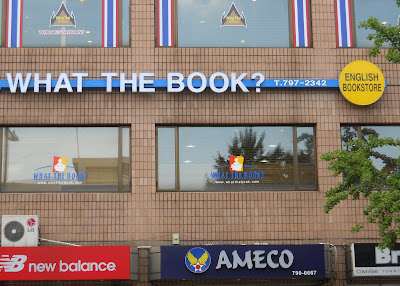
I told myself that the Flashman buying binge was my reward for teaching science to children at summer camp. Then, after camp was all finished, I realized that I hadn't made my acquaintance with the new What The Book? store yet. Once I was in the much improved new location, I had to express my delight (about camp ending and the nice new bookstore) somehow:


4. You Gotta Have Wa - Robert Whiting. An examination of Japanese baseball, or as they say, besuboru. One of these days, I've got to hie myself over to Tokyo or Fukuoka during baseball season and watch a few games.

5. Winter's Bone - Daniel Woodrell. This is the second time I've bought this book. I picked it up at the request of my former colleague Pablo back in 2006 or 2007 during my trip to the US. I remember that wanted to read it before I passed it on to him and collected the money, but decided that it wouldn't be good manners. This will be my first Woodrell novel, although as a novelist from Missouri, he's been in my peripheral vision for several years. I liked the movie version --Ride With The Devil -- of his novel Woe To Live On. After I read Winter's Bone, I hope to see the movie, which has done very well critically.

6. Dead Poets Society - N.H. Kleinbaum. Eeek, a movie novelization! I used to read novelizations a lot when I was a teenager. My favorite place to buy books was the TG&Y store in Lawton, Oklahoma. I remember the rack being thick with them. Gradually, I moved on to reading actual books before they were made into movies.

So why have I regressed? This semester, I have an Intermediate English Conversation class that meets 2 times a week for 2 hours at a time. That's a lot of face time, so I'm going to build a book group into at least one of those hours. Since many young Koreans seem to really identify with this movie/book or are at least familiar with the storyline, I'll try it on for size. We'll finish the semester with a viewing of the movie.
.
7. The Secret Life of Bees - Sue Monk Kidd. Same reason as #6, except that it's for my Beginning English Conversation class. Not one of my favorites, but I think the students will like the book, which came out well before the movie.

Monday, August 30, 2010

Missing Out On A Great Read: The Lost Mind of Me


I was out of BOOKLEAVES for most of the summer because of my trip back to the US, summer camp and all that. Before I left, though, Shanna suggested The Lost City of Z as a future read. At some point, it was decided that this would be our book for the August 29th meeting. I made note of the title and the time when I received Veronica's update.


Perhaps I was distracted by the end of the semester business and busy-ness. Perhaps I was focused on my upcoming trip and didn't pay attention to Shanna's description of the book. I must have had my head elsewhere or I would have noticed the book's subtitle.


However the events transpired, I somehow got the idea that The Lost City of Z was a children's book or perhaps an SF/Fantasy novel. Long story short, I didn't make much of an effort to find this book during Bybee's Book-Buying Binge (BBBB) 2010.
.
When I got back to Korea and was giving all those bookly props and bookish devotion to What The Book?'s new location and its luscious contents, I still didn't seek it out. In my mind, I'd already moved on. So what if I didn't read it? I reasoned. Book group members skip books all the time. Some of the greatest sports heroes in history have warmed the bench a time or two. This would be one of those times for me.


Imagine my surprise and subsequent mortification when I went to the meeting and found out that The Lost City of Z is NOT a children's book nor is it part of an SF/Fantasy series. I can't go on; I'll let Publisher's Weekly via Amazon take over:


In 1925, renowned British explorer Col. Percy Harrison Fawcett embarked on a much publicized search to find the city of Z, site of an ancient Amazonian civilization that may or may not have existed. Fawcett, along with his grown son Jack, never returned, but that didn't stop countless others, including actors, college professors and well-funded explorers from venturing into the jungle to find Fawcett or the city. Among the wannabe explorers is Grann, a staff writer for the New Yorker, who has bad eyes and a worse sense of direction. He became interested in Fawcett while researching another story, eventually venturing into the Amazon to satisfy his all-consuming curiosity about the explorer and his fatal mission. Largely about Fawcett, the book examines the stranglehold of passion as Grann's vigorous research mirrors Fawcett's obsession with uncovering the mysteries of the jungle. By interweaving the great story of Fawcett with his own investigative escapades in South America and Britain, Grann provides an in-depth, captivating character study that has the relentless energy of a classic adventure tale. (Feb.) Copyright © Reed Business Information, a division of Reed Elsevier Inc. All rights reserved. --This text refers to the hardcover edition.

The Lost City of Z is nonfiction! I like nonfiction! It's about an expedition! I like reading about expeditions! The expedition was ill-fated -- even better!


.Realization was slow to dawn, but as Veronica, Bernadette, Jill, Sandra and Shanna all discussed the book in-depth, insightfully and intelligently, I began to warp-speed through Kubler-Ross's famous 5 stages. Swears poured from me like lava. By the time the book was passed to me and I saw the really cool photos and maps and read snippets here and there of David Grann's intriguing prose, I was past swearing. All I could do was make sounds like "gluhr" and "fuhmyop", punctuated by whimpering. I was so flummoxed that I wanted to smite my own forehead, but I wasn't sure I could locate it properly.


.This has been a hell of a month in Bookworm Central. September can only be better.

Saturday, August 28, 2010

Canadian Book Challenge 4: On My Way To 13

O, my Canadians! Once I put my mind to it, it didn't take long to get off to a good start. Here's what I've read so far for this challenge:

Gone To An Aunt's: Remembering Canada's Homes for Unwed Mothers - Anne Petrie. From the 1930s through the 1960s, unmarried Canadian girls who found themselves unexpectedly pregnant were whisked away from their homes and families under the most secret conditions and sent to serve out their pregnancies at homes designed for unwed mothers. When neighbors or friends remarked on the girls' absences, they were told vaguely by family members that they'd "gone to an aunt's."
.
If the term "serve out" sounds a little prison-like, it's not accidental. Many of these institutions, especially the earlier ones, had strict rules about keeping these young women cloistered from society until their babies were born (for example, they could go out into the backyard, but never the front yard in some places or they could only venture out as a group after dark). In some instances, the girls had to assume false names to increase the probability that word wouldn't get out about the girl which could soil her family's reputation.
.
Anne Petrie writes about how the girls including her own story, from the late 1960s) were often made to feel ashamed of themselves, hired out as servants to unsympathetic employers, pressured to give up their children for adoption (unless an unwed father could be brought to the altar) and if a girl wanted to keep her baby, she was met with a brick wall of the staunchest disapproval from everyone. Whether the homes were good or bad, sympathetic or strict, all the women interviewed for the book remembered with anger that their feelings and their wishes weren't taken into account -- weren't even considered a thing of importance.
.
Much the same thing went on the United States, so I wasn't surprised by these stories. Recently, my mother told me about a relative who turned up unmarried and pregnant. The father of the child was willing to marry her, but the two sets of parents were vain and worried about what the neighbors would think, so without any input from the couple, they arranged for them to be married at a courthouse more than 100 miles away then collaborated on a bogus wedding announcement for the newspaper saying that the couple had eloped 6 months before and had only just revealed their marriage.

I feel as if I'm not so far from those days, either. When I was in high school, once a pregnant female student started to show, she disappeared from classes and finished out the term (hers or the school's, whichever came first) at Marie Detty, the local detention center. When I was a senior, one girl managed to fly under the radar since she was already stockily built and big shirts layered with scarves or vests were the fashion at that time. I remember feeling a flash of admiration that she put one over on the administration. It seemed wrong to me that these girls had to go where the really incorrigible kids went. After all, they hadn't destroyed property or harmed anyone.
.
Anne Petrie did good and thorough research and her interviews were in-depth and poignant, but instead of telling each young woman's story in successive chapters, she chronicled their ordeals by the stages of pregnancy. This made it difficult to keep each person straight in my mind as I read. I recommend this book to readers from younger generations so they can compare how much society has changed -- and improved -- in this regard.
.
The Apprenticeship of Duddy Kravitz - Mordecai Richler. Like most of the memorable characters in fiction, Duddy doesn't seem so much created as unleashed. The younger of two sons, (his father and uncle have pinned all their hopes on the older son, who's in medical school) he's always in trouble at school for pulling pranks, and in one example, goes too far and drives a teacher over the edge. A cross between Holden Caulfield and Sammy Glick, Duddy would probably be a totally unsympathetic character except that he's fiercely devoted to his family and has decided to make his grandfather's dream of owning land come true, so even before he's graduated from high school, he throws his intellect and creativity into moneymaking schemes. The novel is set in Montreal, and at times, the city seems almost a character in the story. Richler has a nice sense of pacing, an ear for dialogue that crackles and an indefinable gift for making the reader want to punch Duddy in the nose and hug him all at the same time. If you haven't read this book yet, you've got a treat in store. I'm going to try to find the 1974 movie starring Richard Dreyfuss.
.
The Diviners - Margaret Laurence. If it isn't already, this should be THE Canadian novel. In the story of Morag Gunn, which spans a few decades, Laurence incorporates Canadian nature, history, a couple of provinces (Manitoba and British Columbia) and splendid Canadian vernacular. Written in 1974, this novel has that 70s kind of earnestness, and in lesser hands, could have been a mess. But it's not that at all, it's brilliant. I also read that it shows up on banned books lists, and, relating back to my first Canadian book in this post, Laurence and this novel have been held responsible by some absurd people for causing all the unwed/teenaged pregnancies in Canada! After I finished The Diviners, I went to Wikipedia and read about Laurence's life. I got a chill when I read about her suicide at 60, since there's an episode in The Diviners that seems eerily like foreshadowing.
.
Piling Blood - Al Purdy. I bet Jim and Becka hate to see me coming, because the bookshelves in their living room are getting progressively balder after each visit. I'm not much into poetry, but the evocative images in the title poem made me want to keep reading:
.
It was powdered blood
in heavy brown paper bags
supposed to be strong enough
to prevent the stuff from escaping
but didn't
...

I forgot to say
the blood was cattle blood
horses sheep and cows
to be used for fertilizer
the foreman said

It was a matter of some delicacy
to plop the bags down softly
as if you were piling dynamite
if you weren't gentle
the stuff would belly out
from bags in brown clouds
settle on your sweating face
cover hands and arms
enter ears and nose
seep inside pants and shirt
reverting back to liquid blood...
.
Purdy's range is wide -- he writes about diverse topics such as relationships, Minnesota Fats and his wife, Menelaus and Helen of Troy, his trips to Mexico, the Galapagos Islands, Moscow and other places. I really like that because poetry often feels to me a little cramped up and claustrophobic -- practically airless. Purdy's sense of humor and his sense of wonder emerge in a poem about animals mating. "A Typical Day in Winnipeg" reads like some of the best of Raymond Carver. Purdy is obviously a D.H. Lawrence fan, because there are a couple of poems about him, and the animal-mating poem's title ("The Elephant is Slow to Mate") is from a Lawrence poem. "The Death of DHL" is so immediate, so sad but so beautiful. The last poem, "In The Early Cretaceous" imagines what flowers' first day on the planet was like and how the rest of nature responded to them:
.
They came overnight
a hundred million years ago
the first flowers ever
a new thing under the sun
invented by plants
It must have been around 7 A.M.
when a shrew-like mammal stumbled
out of its dark burrow
and peered nearsightedly
at the first flower whiff
an expression close to amazement
and decided it wasn't dangerous
.
Happily, I'll have the opportunity to read more of Purdy, because Becka and Jim loaned me another volume called To Paris Never Again, which I'll discuss in my next roundup of Can Lit.

Friday, August 20, 2010

The Big Reader

I'm not aware of too many things/I know what I know if you know what I mean...


I was out with some co-workers the other night and it was a little depressing. One of them had heard that I am "a big reader", so he was chatting me up about his favorites.
.
Had I read Gibbon? No.
Voltaire? No. *
Virgil? No.
Euclid? No. **
Spinoza? No.
.
I was feeling pretty uneducated. Oh-so-ignorant. An imposter. Unwashed, too, but that was probably more of a pyschological thing.

Reader Guy smiled. "I guess you're more of a literature lady."

"I guess so."

"Have you read George Eliot?"

"George Eliot's wonderful!" My mouth was watering to discuss Middlemarch.

"I read The Mill on the Floss." Reader Guy told me. He must have assumed I'd read it because he told me the ending. "It was so disappointing to read that long book and [spoiler] at the end."

Sigh.

Just before we all left the bar, Reader Guy told me that when he's home in Canada in the summer, he'll go out and live in the forest and come to town once a week to shower at the gym, get groceries and visit the library. Kind of like Thoreau, I wanted to say, but knowing about Thoreau and Walden seemed so weak and lit-wimpy compared to actually having read Euclid, Virgil and Spinoza.
.
Since that night, I've been walking around muttering to myself: "I haven't read anything. I've never read anything."
.
Funny how things happen just like that. In an instant, my entire literary life fell into the cracks on the floor of the bar and was mopped up along with the spilled, stale beer suds. My bookworm mojo's gone.
.
Footnotes:
*Actually, I did read Candide, but not for fun and pleasure as Reader Guy indicated that he had done. Points off for me because I only read it because it was a World Literature II assignment when I was in college.
.
** Hell, no! Isn't Euclid a math guy or something? Shudder.

Monday, August 16, 2010

Summer 2010: The Unread

After taking careful notes and finding out exactly how bloated my TBR shelf really is, I was going to pull all my unreads off of the shelves and put them on the bed and take a picture.

Problem: The bed's not big enough. The photo above is just a small sample of what's waiting.

Total TBR: 224. Yikes. Actually, at this time yesterday, it was only (!) 222. A couple of hours later, I got a package from my mom and in that package (among other things) was a book that her friend Nancy wants me to read called The Quiet Little Woman by Louisa May Alcott. Tuffi and I were both pleased; the stories date back to the 1870s which was yayness for her and I go through stages where I'm All About Alcott.

Later that evening, I was over at Becka and Jim's for Mad Men Monday and I somehow absconded with Becka's copy of Chocolat. I'm sorry, Becka! Once it touched my hands, I couldn't leave without it. As you can see, things are piling up without my even having to work at it. Wouldn't it be nice to have that tendency with money or real estate?

Here are the unread numbers in my special categories:

Baseball books: 5

Biographies: 5

1930s books: 6

Louis L'Amour's Sackett Series: 18

Pulitzers: 21

Canadian books: 11

Korean-themed books: 3

Graphic novels: 4

Strangely enough, even while I'm listing these particulars and implicitly inviting you to gasp and tut-tut about my biblioextremism, another part of my mind is busily planning how I'm going to work those weekly visits to the Bybee-ary into my schedule this fall and another nother part of that mind is contemplating a visit to What The Book?'s new location.

So much multi-tasking is making my brain tired. I need a nap. Oh, right. There's books all over the bed.

Monday, August 09, 2010

Lit Biopic

Sean Penn in talks to play literary editor

LOS ANGELES (Hollywood Reporter) – Sean Penn is in negotiations to star in a film about Maxwell Perkins, the eccentric literary editor who oversaw the release of works by F. Scott Fitzgerald and Ernest Hemingway.


"Genius" is based on A. Scott Berg's National Book Award-winning 2008 biography, "Max Perkins: Editor of Genius." The movie will focus on the relationship between the fedora-wearing editor-in-chief at New York publishing house Scribner and a young Thomas Wolfe, though the script is peopled with literary characters.

It will be directed by Bill Pohlad, who hasn't shot a movie since the 1990 indie "Old Explorers." In recent years, he has focused on producing films through his River Road banner, including "Brokeback Mountain," "The Runaways" and the Penn-directed "Into the Wild."
.
Aside from the involuntary grimace I gave when I saw the wrong date on Berg's biography -- it was first published in 1979 and won a National Book Award in 1980 -- I'm all smiles. I'd love to see this project fully realized. I'd clamber over hordes of irate, foul-smelling people to be the first in line to buy a ticket for a movie based on Max Perkins: Editor of Genius.
.
This book is one of the best biographies out there. If you haven't read it yet, you're missing a treat. Ever since I read it back in 2001, I've been a Maxwell Perkins AND an A. Scott Berg fan. Great editors, great biographers -- they're both so rare and so valuable.
.
In addition, it's time for a Lit biopic! I haven't seen a really good one since 1994's Mrs. Parker and the Vicious Circle. I have mixed feelings about Sylvia (2003), although I've seen it several times.
.
The image above is of the dust jacket from the first edition. Although that's a caricature of Perkins, it could also be one of Sean Penn. Who'd have thunk it?

Saturday, August 07, 2010

Shelf Shots

After my huge book shopping binge in July, my small apartment was overrun with books. Not the best time to be watching Hoarders Season 1. Doesn't that show freak you out? I was getting all sweaty and nervous about clutter issues; I feared that it was time to either double-shelve or worse, "cull the herd".


Rescue came in the form of Jeremy, who is leaving Korea and has a ton of stuff to unload, including a 2-shelf and a 3-shelf bookcase. I asked for the 3-shelfer, but Jeremy thoughtfully pointed out that the shelves can be stacked. Wobbly as my spatial and math skills are, it didn't take me long to appreciate the beauty of a 5-shelf situation.

Long story short -- Jeremy hauled shelf and I crossed his palm with paper. After he left, I hummed and shoved some stuff around in my own little warped bookwormy version of Apartment Therapy:

The new shelves, stacked. I put my still-incomplete Pulitzer prizewinners collection here in chronological order. As you can see, I've now got room to grow the Pulitzer collection. On top of the shelf is The Dictionary of Cultural Literacy, a Webster's Collegiate Dictionary, a booklet that lists local train times and subway schedules and Leonard Maltin's 2010 Movie Guide. The book next to the yellow pillow is Savage Night by Jim Thompson.


Here's a closer peek at the top of the bookshelf that's in my header. This mixture of books includes books I've borrowed, traded, found and bought in recent months. Also a mixture of unread and partially read.


The shelves below this one house my DVD collection, but the top one is the special place for my full-color collector's edition of Little House on the Prairie books. I think it's pretty clear by now that I'm a "bonnet head".


The Bookshelf Formerly Known As Pulitzer was moved over by the patio door. On top of the shelf is Jeremy's little wooden display thing, which holds my dolls from Mongolia, a matyroshka doll I found in Incheon's Chinatown and two toy turtles. On the next shelf are the Louis L'Amour Sackett series and my reading journals. On the shelf below are some TBRs. A little more than 2 empty shelves make me a happy bookworm, but you know what they say about nature (and it goes double for Bybee) abhorring a vacuum, right?

Thursday, August 05, 2010

July 2010: What I Read

This has got to be one of my stranger lists of reading-by-the-month:

1. Korea: A Walk Through The Land of Miracles - Simon Winchester. Back in the late 1980s, Simon Winchester set out to walk across South Korea. Most of his observations were spot-on, and I was happy to see that he walked very close to where I live now, but overall, I'd prefer a little less about Winchester (especially about how he's so irresistible to Korean salon girls, ew) and a little more about Korea.

2. The Killer Inside Me - Jim Thompson. Even with the movie version recently released, it was difficult to find any of Thompson's novels. I finally had success at a Borders in Kansas City. Dang. I wasn't expecting Thompson to be so compulsively readable, so twisted and nightmarish or so darkly humorous at turns. This sick and brilliant foray into the mind of a psychotic killer made me jumpy and I was glad that people were nearby. In spite of feeling so disturbed, my appetite was whetted for more of Thompson's work. Fellow CRACKED SPINZ crony Paul brought back Pop. 1280 and Savage Night from England and I can't wait to read them.

3. The Plump Pig - Helen & Alf Evers. I sat close as Mom did a read-aloud. We'd both forgotten that while the title character was still living with the skinny farmer, he skipped going to the trough at mealtime and ran around the yard to get thinner, so that he might fit in. He only grew plumper and sadder. Sigh. Hooray for the plump family who was out for a drive one day!

4. Tinkers - Paul Harding. Ever since reading and loving The Brief Wondrous Life of Oscar Wao two years ago, the successive winners of the Pulitzer Prize have seemed really muted, very quiet in tone by comparison. Tinkers reminded me so much of Gilead, (Two old men in reflection at the end of their lives) except Tinkers was a little more metaphysical and Gilead seemed more religious/philosophical. I admire Harding's novel, but it was like peering for treasure in fog.

5. Blockade Billy - Stephen King. I'm more used to Stephen King going on for hundreds of pages. This entertaining novella (you can tell that King loves the language of baseball and relishes an opportunity to dive right in and use it with great abandon) felt like it ended before it got started properly. The other title in the volume, a long short story called "Morality" didn't seem to go with the title offering.

6. Nurse Nancy - Kathryn Jackson, Corinne Malvern. My preschool favorite appeared before me in a toy store in Amana, Iowa. I had to have it. They still include the decorated plastic bandages on the title page, although the ones in my orginal copy were different shapes like stars and hearts.

7. Somewhere To Belong - Judith Miller. The story of two young women in 1877 with Amana Colonies as the backdrop. Johanna has lived in Amana all her life and wonders about life beyond the colonies. Berta's parents have abruptly moved to Amana after living a well-to-do lifestyle in Chicago. Johanna is assigned the job of teaching angry, rebellious Berta how to fit in at Amana. Berta is the fish-out-of-water that enables the reader to see inside the Utopian community. Miller's depiction of the day-to-day rigorous schedule is instructive, entertaining and, since Berta and Johanna are put to work in the kitchen, mouthwatering. Both girls' families are harboring secrets, and both girls are determined to know exactly what's going on. Meanwhile, a man from another part of the Colonies has begun to show an interest in Johanna. Since Christian fiction and romance are not my favorite types of reading, I was surprised at how much I enjoyed this wholesome novel. Recommended to me by Mom, who says she "lived every minute of it", which is her ultimate praise for a book.

8. Flashman - George MacDonald Fraser. Harry Flashman, the bully who terrorized younger and smaller students at Rugby school in Tom Brown's School Days (in one memorable scene, he and one of his thuggish friends attempt to literally roast Tom in front of the fire!) picks up writing his "memoirs" where Thomas Hughes left off. Being expelled from Rugby for drunkenness doesn't slow Flashy down; he decides to join the military. In quick succession, he's shuttled off to Scotland, India then Afghanistan, the latter to his great unease. Flashman makes no bones about being a self-professed "lily livered" coward who rarely thinks beyond his next ride (you can take that however you want) or his next drink. Flashman's smart-ass narrative keeps the action moving swiftly and Fraser, the "editor" of this series of memoirs, provides notes backing up Flashman's amazing historical accuracy or clarifying a few points. I'm now reading Royal Flash, the second volume of the series. Ooooh, gorgeous stuff...it's like candy. Flashy's a rake, a ramblin' man, a villain, a coward and a certified gold-plated bastard, but he's hilarious and I can't help loving him.

Tuesday, August 03, 2010

Blame Canada?!

.

My numbers were as putrid as ancient cheese curds for the last Canadian Book Challenge. Five books out of thirteen! I only made it to the Snowshoe level. Mortifying. I let my neighbo(u)rs to the north down badly. If Alex Trebek knew....? No. Some imagined scenarios just can't be borne.

So I thought to myself that I'd skip out on the challenge this year. Not so good, eh? But while I was home (and so much closer to Canada!) I watched Regis and Kelly visit Prince Edward Island. When Kelly dressed up like Anne of Green Gables and reenacted that first book, I started to get maple leaf pangs. Then I went to Minnesota and I was in a state that touches Canada. That did it. I knew I was good for another round.

Yep, I'll start my Canadian reading this month. I'll get caught up to where I need to be. Reading about a place notorious for its cool climate may save me from heatstroke.

Sunday, August 01, 2010

June, 2010 Reviews and Comments

I'm trying not to get too far behind on my reviews like I did last year. Only 6 for June, but really high-quality, engrossing reads:

1. Ella Minnow Pea - Mark Dunn. A cute-but-deep epistolary novel about letters being banished from the alphabet on a small island in the United States. As the book progresses, the correspondence gets a little stranger and more convoluted because use of the outlawed letter carries harsh punishment. Dunn gives readers plenty to think about in the areas of superstition and censorship. Thanks to Shanna for passing this one on to me.

2. Fever Pitch - Nick Hornby. Who better to get me ready for World Cup than my beloved Nick? I'm pretty familiar with Nick the booklover, and Nick the soccer fanatic has many of the same qualities. Hornby details his obsession with the fortunes of London Arsenal since he was 11 year old. He's really interesting when he gets into fan mentality. Highly recommended.

3. Love and Hate in Jamestown - David A. Price. According to Peggy Lee, "Captain Smith and Pocahontas had a very mad affair". Except they didn't. John Smith was in his late 20s when he sailed from England to Virginia to establish a settlement at Jamestown. Unfortunately, he was with a bunch of losers who had been hanging on their family trees like so much rotten fruit till their fathers dispatched them to the New World. Even then, the wastrels thought that they'd never have to work because they'd be tripping over huge chunks of gold every time they went to the privy.

Only Smith (not noble born like the rest) seemed to have an understanding about the amount of work needed and the diplomatic skills to manage the delicate situation between the colony and the various Native American tribes living around Jamestown. When Smith wasn't around or wasn't in charge, things got ghastly very quickly. The Starving Time chapter makes for horrendous reading.

Meanwhile, there was Pocahontas. She saved Smith from her father Powhatan's edict of execution, but she was a child of 10 or 11 years old. She and Smith crossed paths once or twice more, but only fleetingly. Pocahontas ended up marrying an Englishman, John Rolfe, having a son, being presented at court then dying very young.

Price is an excellent writer who describes things very keenly and keeps the prose moving swiftly while still rolling out the facts. Now that I've read this book, I'd like to go back and watch the 2005 Terrence Malick film. My only complaint about L&HIJ that there were no pictures with the text.

4. The Black Pearl - Scott O'Dell. When Ramon finds the pearl of the title, also known as The Pearl of Heaven, he believes that his fortune has been made, but an ancient fisherman warns him that he's only succeeded in incurring the wrath of the sea monster living in their area. Kind of like Steinbeck's The Pearl for the elementary school set.

5. How Soccer Explains The World - Franklin Foer. Most countries feel strongly about soccer, but their culture plays a big part in how they express that love....or ambivalence, in the case of the United States. Standout chapters include a look at hooligan fans in the United Kingdom, an in-depth look at Foer's personal favorite team, Barcelona, Female Iranian fans protesting being banned by clerics from seeing matches and the fish-out-of-water story of how a player from Nigeria came to play for the Ukraine. Foer was so effective in communicating his love for Barca that I was really pleased to subsequently see Spain win the World Cup.

6. Interpreter of Maladies-Jhumpa Lahiri. All 9 of these stories are brilliant, but the title story is the showstopper. I'm smiting my forehead because I took so long to get around to reading this 2000 Pulitzer prizewinner. Jhumpa Lahiri is on the same level as Chekhov or Carver or Mansfield. Did I already say brilliant? I'll definitely be reading more of her writing.